

A version of the following public comment was submitted to the Rhode Island Senate Finance Committee on May 12, 2026.
Senate Bill 2098 would severely limit legal options for adult smokers in Rhode Island to switch from the most dangerous form of nicotine consumption to one that is substantially safer.
Food and Drug Administration review and tobacco harm reduction
The Food and Drug Administration (FDA) recognizes there is a “continuum of risk” when it comes to tobacco products, with cigarettes being the most dangerous and alternatives such as e-cigarettes, smokeless tobacco, nicotine pouches, and heated tobacco products being less dangerous. As such, when the FDA authorizes a new tobacco product for sale, it must be evaluated as to whether it is “appropriate for the protection of public health,” meaning the product must provide a net benefit to public health. Six such menthol e-cigarette products have been authorized by the FDA.
If Rhode Island chooses to ban these products, it will hamper efforts to reduce the prevalence of tobacco-related diseases, which remains the leading cause of preventable death in Rhode Island, with around 1,800 residents dying per year from smoking.
Removing adults’ access to flavored e-cigarettes, when there is still significant demand, can result in unintended consequences. According to a survey conducted by the International Tobacco Control Policy Evaluation Project, 57 percent of vapers said they would continue vaping if flavors were banned, while half said they would find another way to get their preferred flavor. Of most concern to public health officials and lawmakers should be the finding that close to one in five vapers said that if their preferred flavor was banned, they would stop vaping and smoke traditional cigarettes instead.
In 2018, San Francisco banned the sale of all flavored tobacco products, including e-cigarettes with flavors other than tobacco. Yale University’s Abigail Friedman found that after the flavored tobacco ban was enacted, San Francisco area youth were twice as likely to smoke compared to young people in similar jurisdictions that had not enacted tobacco flavor bans. “While neither smoking cigarettes nor vaping nicotine are safe per se, the bulk of current evidence indicates substantially greater harms from smoking, which is responsible for nearly one in five adult deaths annually. Even if it is well-intentioned, a law that increases youth smoking could pose a threat to public health,” found Friedman.
Rhode Island does not have a ban on menthol cigarettes. It would be contrary to all sound public health policy to ban a safer substitute for menthol cigarettes, i.e., menthol e-cigarettes, while menthol cigarettes themselves remain on the shelves.
Youth use and the 2025 national youth tobacco survey
Bans on flavored e-cigarettes are frequently justified on the grounds that they might entice youth to experiment with nicotine. The most current evidence does not support this concern. The 2025 National Youth Tobacco Survey found that high school vaping has fallen 74 percent since its 2019 peak of 27.5 percent, with no national menthol flavor ban in place. Past 30-day use among high school students for e-cigarettes is 7.1%, significantly lower than both youth marijuana and alcohol use.
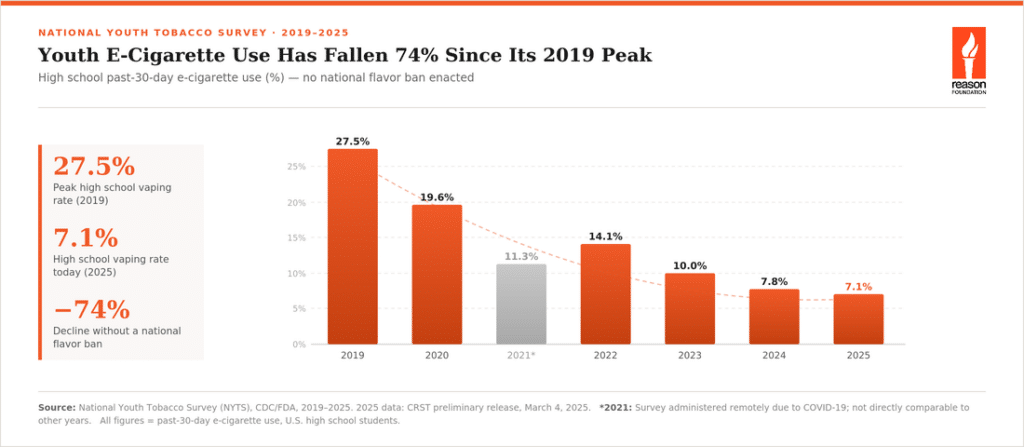
On first appraisal, these low numbers may be surprising given the fact that the illicit e-cigarette market has surged in recent years, with thousands of flavors, principally imported from China, becoming available. But data released by the Centers for Disease Control and Prevention (CDC) shows flavors are not the leading reason why youth initiate vaping. According to the CDC, the primary reason why young people say they start vaping is curiosity, followed by peer influence or family members. Availability of flavors such as menthol, candy, fruit, or chocolate ranks a very distant third in the survey.
Conclusion
SB. 2098 would restrict legal access to FDA-authorized, reduced-risk products for the adult smokers who need them most. Banning a safer substitute for menthol cigarettes while menthol cigarettes themselves remain freely available is contrary to the best interests of public health. The committee should consider whether FDA regulation and continued public health surveillance are already achieving much of what SB. 2098 intends to accomplish.