

A version of the following public comment was submitted to the New Hampshire Committee on Housing on February 2, 2026.
We share the same goals as the sponsors of House Bill 1136: strengthening property rights and expanding housing options by removing unnecessary regulatory barriers. HB 1136 advances these goals by addressing a narrow but consequential constraint in current law that limits the use of existing structures for accessory dwelling units.
ADUs are entirely voluntary for homeowners and require no public funding, making them a valuable tool for expanding affordable housing supply. Legislation allowing their use would give New Hampshire’s property owners more flexibility to use their land in ways that make sense for their households and finances, while creating small and affordable housing options.
Importantly, allowing ADUs in single-family neighborhoods:
● Creates an opportunity for infill, using land and infrastructure efficiently without altering the architectural character of existing neighborhoods.
● Offers more choices for households with diverse sizes and incomes, including students, downsizers, and multi-generational families.
● Allows property owners to generate an additional stream of income while adding to the stock of affordable housing in New Hampshire.
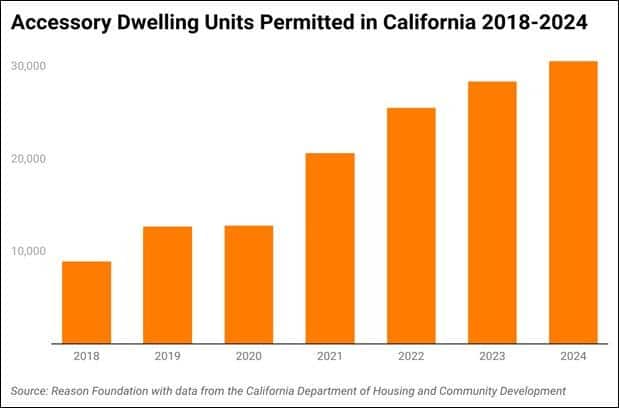
Evidence from other states that have enacted similar legislation demonstrates that landowners are willing to build these units if given the opportunity. Since 2016, California has passed a series of state laws making it easier to build ADUs. Between 2018 and 2024, the state has added over 139,000 ADUs, with annual permits increasing every year (except during the height of the COVID-19 pandemic in 2020). These units have provided housing options for households across the income spectrum.
HB 1136 is especially valuable because it focuses on the conversion of preexisting nonconforming structures, rather than new construction. By allowing ADUs within or attached to existing buildings that already occupy the lot, the bill removes a technical barrier that currently prevents housing creation even where safety and zoning standards can be met.
Evidence from other states shows that when legal barriers are reduced, property owners are willing to add ADUs. California’s experience demonstrates that enabling incremental housing through ADU reform can meaningfully expand supply over time, particularly when homeowners are allowed to adapt existing structures.
HB 1136 represents a targeted and practical reform that respects local safety standards while better aligning land use regulation with market realities. By removing an unnecessary constraint on existing property, the bill supports responsible, homeowner-driven housing solutions without mandates or public subsidy.