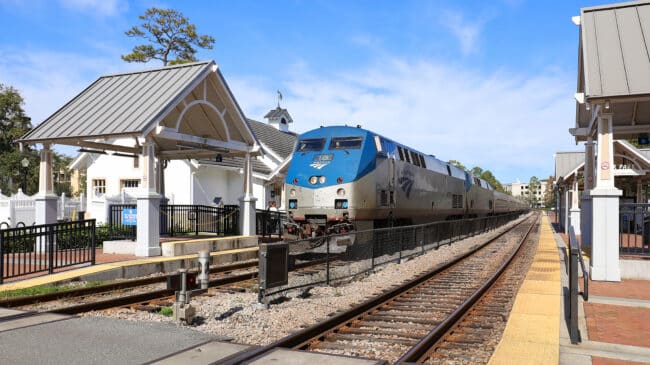

America’s passenger rail system, the National Railroad Passenger Corporation, or Amtrak,was born out of the collapse of private passenger rail services and a government commitment to maintaining a connected transportation network.
Over the decades, Amtrak has faced mounting challenges, including rising operating costs, chronic delays, and sprawling infrastructure that relies heavily on federal subsidies and the use of track that does not belong to Amtrak.
At the same time, intercity bus services have evolved into leaner, market-driven alternatives, offering faster travel and lower fares in many key corridors.
This study provides a detailed, side-by-side evaluation of Amtrak and intercity bus services across critical dimensions such as ticket pricing, convenience and accessibility, travel speed, profitability, subsidy reliance, and on-time performance. It compares eight intercity Amtrak routes to comparable bus routes.
For each of the eight routes, this analysis compares existing Amtrak service with intercity bus options between the same two cities, revealing stark contrasts between an aging, resource-intensive rail network and a more efficient bus system.
By comparing performance data across diverse routes—from the Northeast to the West and South—the findings of this study highlight the need for a strategic overhaul of Amtrak. The findings support an approach that focuses on sustaining high-performing, near-break-even routes while phasing out persistently unprofitable ones.
The comparative analysis clearly shows that many Amtrak routes operate under significant financial and operational challenges. When measured against intercity bus alternatives, several key corridors highlight stark differences in travel time, cost, and on-time performance.
Amtrak routes such as the Capitol Limited, Empire Builder, and California Zephyr frequently incur substantial operating losses, while bus services consistently provide a faster and more cost-effective alternative, though both modes are lacking in on-time performance.
From a rider’s perspective, the tradeoff is often the same: cost and expedience versus comfort.
These findings underscore the unsustainability of attempting to maintain an expansive network that dilutes resources and skirts over long-standing operational inefficiencies. It’s time for Amtrak to take a more focused approach on which routes should be maintained. By slimming down its network and prioritizing routes that are near break-even or already profitable (such as Northeast Regional, though, as explained in Section 4.4, that profitability assessment does not consider capital costs), Amtrak can better allocate federal support while improving overall service quality.
Concentrating investments on promising corridors would pave the way for technological innovation and operational overhauls, creating a leaner, more competitive long-distance transit system that meets modern performance standards.
Full Study: Evaluating Amtrak and intercity bus performance for smarter federal investment
Download this Resource
Evaluating Amtrak and intercity bus performance for smarter federal investment
Thank you for downloading!