

With state legislative sessions in full swing, some clear trends are emerging and open enrollment is leading the way. This year, 31 states are considering nearly 100 open enrollment-related proposals during their current legislative sessions.
At least 36 of the bills would improve states’ scores on Reason Foundation’s open enrollment scoresheet, which examines and grades states’ open enrollment laws based on seven best practices, including permitting cross- and within-district open enrollment, state and local transparency provisions, and ensuring that school districts can’t charge tuition to public school transfer students.
K-12 open enrollment allows students to transfer to public schools other than their assigned schools when extra seats are available. A Dec. 2025 YouGov poll found that 74% of K-12 parents supported strong open-enrollment laws.
Since 2021, policymakers in 17 states have taken note, strengthening their open enrollment laws. During this time, the number of states with strong cross-district open enrollment laws, which let students transfer to schools in other school districts with open seats, increased from seven to 16.
Similarly, seven states established robust within-district open enrollment laws so students can transfer to public schools with open seats inside their district other than their assigned one, increasing the number of states with within-district transfer policies of this caliber to 17.
Figure 1 highlights states whose 2026 open enrollment proposals would be most impactful if codified, per Reason Foundation’s best practices.
Figure 1: Most notable open enrollment bills of 2026
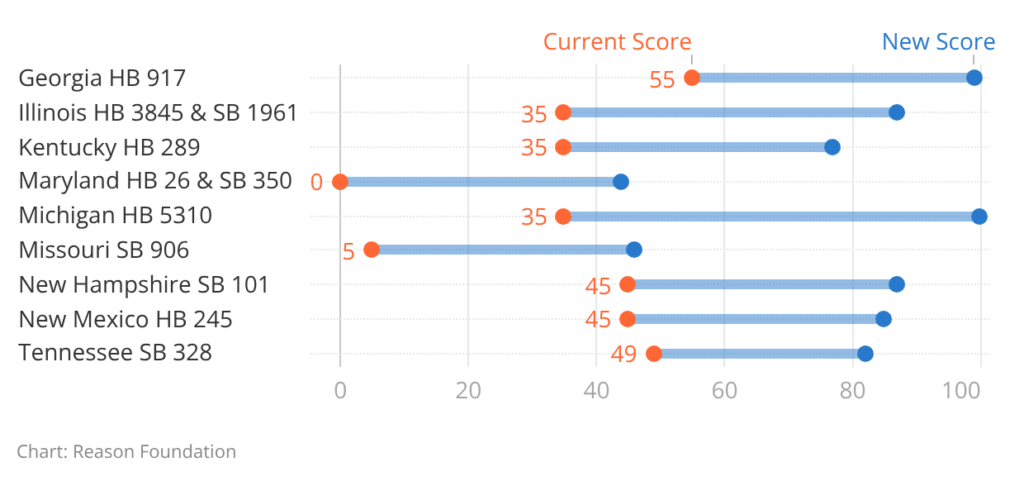
Michigan’s proposed open enrollment bills, if passed, would be the most significant and establish the state as the preeminent leader in open enrollment nationwide, surpassing Oklahoma, which currently has the best open enrollment law in the nation. However, Michigan’s bill has not yet passed the House Education Committee.
Likewise, active proposals in Georgia, Illinois, New Hampshire, New Mexico, and Tennessee would improve their current open enrollment score from a grade of “F” to a grade of “A” or “B” per Reason Foundation’s scorecard.
In other cases, such as Maryland and Missouri, policymakers proposed incremental reforms that are still steps in the right direction.
For example, Maryland House Bill 26 and Senate Bill 350 would establish discretionary open enrollment programs, making school district participation optional and ensuring that transfer students aren’t charged public school tuition. Currently, Maryland is one of the four states without an open-enrollment policy established in state code, so this would be progress.
Overall, if all the proposed open enrollment bills in Figure 2 are codified, the number of states with strong cross-district open enrollment laws would increase from 16 to 23. The number of states with solid within-district open enrollment laws would increase from 17 to 18.
To date this year, only Nebraska has codified an open enrollment proposal, Legislative Bill 653. While this bill doesn’t affect the state’s score, currently a B- grade in Reason’s review, it strengthens the state’s policy by requiring school districts to accept the siblings of current transfers regardless of capacity restraints.
In two other states, Utah and Mississippi, open enrollment proposals have already failed to pass. Utah House Bill 528 would have improved open enrollment transparency at the state level, improving its grade from an “A-” to an “A”.
In Mississippi, a modest reform, Senate Bill 2002, would have eliminated an onerous restriction that requires transfer applicants to receive approval from both the sending and receiving school districts, but the plan died in the House.
Despite those two setbacks, lawmakers across the country can still pass bills that would help students by improving their states’ open enrollment policies. Policymakers should seize the current opportunity to let students attend public schools that are the best fit for them.
From the states
Mississippi’s governor mulls calling a special session, and Tennessee policymakers advance a private school choice expansion in the House.
Mississippi Gov. Tate Reeves announced that he may call a special session about teacher pay and school choice if the legislature fails to reach an agreement. Specifically, the governor stated that these issues should be “tied together,” The74 reports. But House Speaker Jason White, who pushed school choice, said, “No one in the legislature is tying school choice policy to a teacher pay raise.”
In Tennessee, a House subcommittee approved House Bill 2532, which would increase the number of participants in the state private school scholarship program from 20,000 to 40,000. During the 2024-25 school year, participants received scholarships valued at $7,500 on average per student to pay for private school tuition, textbooks, tutoring, and other approved education expenses. The program prioritizes students from households whose incomes are below 300% of the federal poverty line or who have disabilities.
The Florida legislature passed Senate Bill 182, which would let small private schools (enrolling 150 students at most) operate in zones designated for commercial or mixed-use purposes as long as the facilities comply with the Florida Fire Code Prevention Code.
Kentucky Gov. Andy Beshear vetoed House Bill 1, which would have opted the state into the new federal tax-credit scholarship program. However, Republican lawmakers have promised to override the governor’s veto. Earlier this year, Senate President Pro Tem David Givens (R-Greensburg) said, “And if you [Gov. Beshear] choose to veto, you know it’s going to be overridden. That is what it is,” the Kentucky Lantern reported.
What to watch
Three states announced they will reconsider their initial opposition to the federal tax-credit scholarship program; Vermont families sue over restrictions to the state’s tuitioning program.
A second lawsuit was filed in Vermont against Act 73, arguing that its restrictions on the state’s private school tuitioning program significantly limit students’ education options. The tuitioning program lets students attend private schools at public expense when their assigned school district doesn’t offer their grade level. In 2025, a new law prohibited eligible students from transferring to private schools outside Vermont or to private schools within a school district that offers schooling at all grade levels, likely excluding private schools in denser areas.
Three states, Oregon, Hawaii, and New Mexico, are reconsidering their initial statements that they would not participate in the new federal tax-credit program. These reassessments follow Gov. Jared Polis’ announcement that Colorado would participate in the federal program. So far, Wisconsin and Kentucky are the only states officially opposed to the federal program. To date, 28 states have announced intentions to participate in the federal program. Set to launch in 2027, the new law allows individual taxpayers to contribute up to $1,700 annually to an approved scholarship-granting organization. Scholarship recipients may use these funds to cover approved education expenses, such as private school tuition, tutoring, or school uniforms. The map below shows the states that have announced decisions to participate in the program.
Figure 2: States that have announced decisions to participate in the federal tax-credit scholarship program
The latest from Reason Foundation
Missouri Senate bills 906 and 971 would improve open enrollment
Putting parents in the driver’s seat of public education
Reason Foundation also submitted testimony on open enrollment proposals in Utah and Maryland.
Recommended reading
National, State Data Point to Slow Pace of Pandemic Recovery
Linda Jacobson at The74
“A recent report on pandemic learning loss from NWEA, an assessment company, captured that combination of frustration and hope over the state of academic recovery. About a third of schools have reached pre-COVID performance levels in reading or math, and just 14% have recovered in both subjects. But even some that were hit the hardest, like high-poverty schools, have made impressive gains.”
School Choice Competition vs. New Education Spending
Patrick Graff, Ph.D., American Federation for Children
“The results are striking: scaling the tax credit scholarship program from 15,000 to over 100,000 students produced achievement gains for public school students that were – conservatively – over 11x larger than if that same funding had been used to increase state K-12 education budgets instead. Critics warned that expanding the state tax credits available to fund private school scholarships would come at the expense of public schools across the state. The best evidence we have suggests otherwise. Florida’s policy environment benefited both public and private school students, as the effects of competition created a return on investment an order of magnitude larger than simply spending more.”
SCOTUS: The Child Is Still Not a Mere Creature of the State
Robert Pondiscio, American Enterprise Institute
“California’s policy did not merely encourage sensitivity; it instructed educators to conceal from parents a child’s gender transition at school, including the use of new names or pronouns, unless the student consented to disclosure. The justification was protective: Some students could face hostility or emotional harm if parents were informed. Yet the effect was to institutionalize secrecy between schools and families on matters deeply intertwined with a child’s psychological well-being. That’s not a routine privacy decision. It is a profound intervention into the parent-child relationship.”