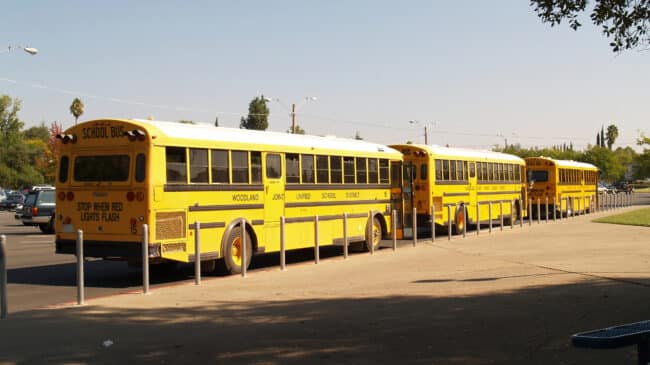

The yellow school bus has long been emblematic of public schooling nationwide. However, its role as many K-12 students’ primary mode of transportation is in decline.
The K-12 education landscape is markedly different today than it was in 1980, when more than 59% of students were transported at public expense. The latest federal data showed that this rate shrank by almost eight percentage points as of the 2018-19 school year. More recently, state-level data collected by School Bus Fleet Magazine found that 43% of public school students in 47 states (excluding Arizona, D.C., Louisiana, and Oklahoma) were transported daily during the 2023-24 school year.
These lower ridership numbers could be due to a variety of reasons, such as parents driving students to school (a 2024 HopSkipDrive survey found that 79% of families “manage school transportation independently.”) Additionally, fewer students could be riding the bus because of an increasingly competitive education marketplace. For example, between 2019 and 2023, the number of homeschool students increased by 21%. Similarly, private school choice program participation grew by more than 800,000 students between 2019 and 2025, an increase of 164%.
As a result of these changes, along with urban sprawl, many school buses now travel further to transport fewer students at a higher cost per capita. Between the 1980-81 and 2018-19 school years, the average expenditure per student transported by bus increased from about $785 a student to nearly $1,454 in inflation-adjusted dollars, an increase of almost 92%.
Combined with bus driver shortages, these factors brought student transportation crises to a head in several districts in recent years, forcing them to change or eliminate bus routes. This had real consequences for students reliant on buses: some Indiana students missed school because they lost their transportation in 2023, for example, and Ohio’s Mentor School District canceled school altogether for a day earlier this year due to a driver shortage.
These shortcomings are bad for public school students, many of whom are already behind due to pandemic-induced learning loss. At the margins, these bus woes could contribute to chronic absenteeism. To modernize and remedy these transportation problems, state policymakers should adopt policies that make it easier for students to get to school, including relaxing onerous regulations that limit the types of vehicles that school districts can use to transport students.
For example, “For efficiency reasons, I’d like to use smaller vehicles like vans or town cars for these one-off trips [to transport homeless students], but state law doesn’t allow it,” the executive director of transportation of Atlanta Public Schools, John Franklin, told Bellwether Partners.
Loosening regulations so school districts can transport many students with small passenger vans would be a good starting point. Districts can use these vehicles to transport small numbers of students who live in rural areas, transfer to their schools from other districts or attendance zones, or are homeless.
Organizations, such as HopSkipDrive, are helping blaze these new trails. Since its launch in 2014, it has arranged more than five million rides for students in 17 states by providing districts with supplemental transportation options. This includes helping districts be smarter about their bus routes and providing personalized transportation services for students who can’t easily access main bus routes, such as students transferring via open enrollment or those with Individualized Education Plans.
While the service’s drivers for small passenger vans receive extensive background checks and must have five or more years of caregiving experience, they don’t need commercial licenses, like bus drivers. This makes it easier to find and hire drivers for these vehicles, getting more kids to school on time.
In Indiana, lawmakers approved a new program to streamline transportation services across districts, charter schools, and private schools. Participating schools can pool their resources to transport students to specialized learning experiences, such as career and technical education, Chalkbeat reported.
The problems that make it harder for districts to transport students to school aren’t going away. Accordingly, it’s important for policymakers to give school districts the flexibility necessary to help students get to school so they can learn.
This doesn’t mean that the yellow school bus will disappear anytime soon. For many school districts buses will remain a critical staple of their transportation infrastructure, getting kids to school. What’s changing, however, is that yellow school buses shouldn’t be the only transportation option operated by districts. Instead, districts should incorporate other, more nimble transportation options that help more students get to school, streamline services, and save taxpayer dollars.
What to Watch
Tennessee’s robust private school choice law faces legal challenges, the Texas comptroller announced the rules to operate the state’s new private school choice program, and five governors plan to opt into the federal tax-credit scholarship program.
A new lawsuit challenges the constitutionality of the Tennessee Education Freedom Scholarship Act, which made 20,000 private school scholarships, valued at more than $7,000 per student, available to students across the state. The plaintiffs argue that the program undermines the state’s obligation to maintain a system of free public schools. However, the Associated Press reported that Gov. Bill Lee, who championed the scholarship’s expansion, is confident that the courts will uphold the program.
In Montana, a district court blocked the implementation of the state’s new education savings account program for students with disabilities, ruling that its funding mechanism was unconstitutional. However, the judge did not concur with the plaintiff’s claim that the program infringed on the local school board’s authority, according to the Montana Free Press’ Jacob Olness. Instead, “the court found that the Legislature holds broad authority over how state education dollars are collected and distributed,” he explained.
The Texas comptroller finalized rules that spell out the details of the state’s new private school scholarship program, which launches next school year. Students can receive scholarships valued at $10,000, and those with disabilities can receive scholarships valued up to $30,000. However, the new rules clarify that student selection will prioritize applicants with disabilities, followed by those whose family income is below 200% of the federal poverty level. Private schools that participate must be accredited and have an operational campus for at least two years. They must also administer a nationally normed test.
The Missouri Board of Education announced its support for K-12 open enrollment, a policy that allows students to transfer to public schools other than their assigned school. Missouri is one of seven states that doesn’t have a codified policy that lets students transfer to public schools in other districts, according to Reason Foundation’s Public Schools without Boundaries. However, Missouri legislators have introduced proposals to codify open enrollment for the past five years.
Governors in six states–Colorado, Nebraska, North Carolina, South Dakota, Tennessee, and Texas–have announced plans to participate in the new federal tax-credit program set to launch in 2027. However, only Nebraska and North Carolina have taken official action to opt into it. The new law allows individual taxpayers to contribute up to $1,700 annually to an approved scholarship-granting organization. Scholarship recipients can use these funds to pay for approved education expenses, such as private school tuition, tutoring, or school uniforms. To date, only New Mexico, Oregon, and Wisconsin have announced plans to opt out of the program.
The Latest from Reason Foundation
–What state policymakers should know about homeschoolers
–Southern California school districts spend big, but student outcomes have barely budged
–Why teacher salaries are stagnant
Recommended reading
Choice programs should differentiate funding
John Kristof at Informed Substack
“When state legislatures convene next month and discuss how to start or improve school choice programs, they must figure out a way to include differentiated funding. Some programs have already proven it’s doable. This attention to detail could help low-income kids, children with disabilities, children learning English as a second language, and potentially even more traditionally underserved kids receive education that actually works for them. That is equitable, that is fair, and that is freedom.”
BAKER DEMERS: EFA Parents Are Unsung Heroes Supporting Both Their Communities and Their Kids
Kate Baker Demers at NH Journal
“EFA families continue supporting their public schools even after their children leave, contributing the same local property taxes as every other household. What sets them apart is that they take on a second financial commitment – paying for the schooling that finally meets their children’s needs. Whether it is tuition, specialized curriculum, tutoring, or homeschooling resources, these parents willingly carry an additional burden so their children have a chance to thrive.”
Seattle Schools Are Surveying Teens on Sex, Gender, Drug Use — and Sharing the Data
Kamden Mulder at National Review
“A group of 23 Seattle parents expressed concern in a letter to King County, obtained by NR, that third-party organizations could ascertain the identity of individual survey respondents based on their PII and the intimate details students provide when answering survey questions. Those parents demanded that the school district be required to obtain their written permission before their child’s data is shared with any third party.”