
Several months ago, I received an email from an airport consultant in the United Kingdom. He was preparing a global report on the prospects for whole-airport long-term public-private partnerships and wanted my outlook for the United States. I wrote back that no such projects were on the horizon in the United States and had explained why in my recent policy paper: primarily, the lack of any airport owners who are open to this approach.
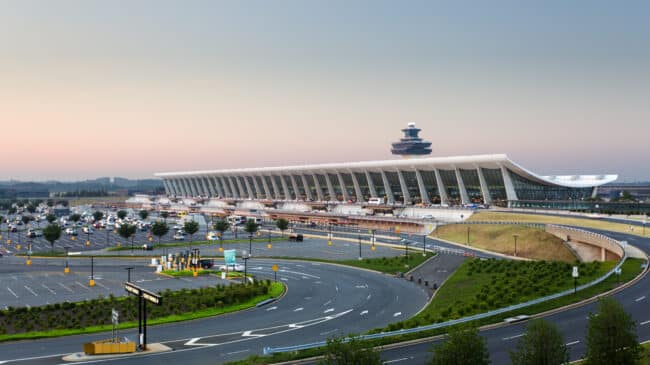
Thus, when the U.S. Department of Transportation issued a request for information (RFI) on a potential project to expand and modernize federally owned Washington Dulles International Airport, I was both surprised and pleased. Dulles International is far from a first-rate airport for the capital city of the world’s most economically productive nation. Its original facilities are old, and newer ones were cheaply cobbled together. Access from the main terminal to the other terminals is poor, with passengers facinga combination of long walks and standing-room-only ‘mobile lounges.’ In my experience, Dulles International Airport compares poorly to major global airports such as London Heathrow, Frankfurt, and Sydney.
The transportation department’s RFI seeks bold visions for a world-class international airport and explicitly refers to long-term public-private partnerships (P3s) as a vehicle to bring this about. By the January due date, USDOT had received 14 responses. A number of these suggested public-private partnerships for individual facilities, such as new terminals. Several proposed long-term design-build-finance-operate-maintain P3s, such as those that have modernized and improved airports in Europe, Latin America, Asia, and Australia over the past three decades.
Macquarie submitted a three-page overview of its 20 airport public-private partnership projects, dating back to 2001, across Europe, Canada, Latin America, Asia, and Australia. Its response also noted a widely-cited 2023 study, All Clear for Takeoff: Evidence from Airports on the Effects of Infrastructure Privatization, from the National Bureau of Economic Research (NBER 30544), which found larger gains in performance from long-term airport P3s that included private equity funds.
Ferrovial, by contrast, submitted a 50-page response that actually sketches out a potential makeover of Dulles, including illustrations of an expanded, better-accessed set of terminal facilities, along with significantly improved ground access to and from the airport. It also highlighted a policy change that would be very positive for long-term U.S. airport P3s: allowing tax-exempt airport muni bonds to be transferred to the P3 company, rather than being defeased or paid off.
That tax policy change has been supported by USDOT’s Transportation Advisory Board, as reported in the December issue of Public Works Financing. I proposed this change in my 2025 paper on incentivizing U.S. airport public-private partnerships, which was commissioned by a joint project of the American Enterprise Institute and the Brookings Institution. That paper highlights the changes needed to enable U.S. airport P3 leases to compete on a level playing field with airport P3 or privatization activity in Europe, Latin America, and the Asia-Pacific.
In long-term airport public-private partnership lease agreements, the proceeds to the airport owner would, in most cases, be far higher if those bonds could be passed along to the P3 company. The amount bid would reflect the airport’s estimated gross value rather than the gross value minus the amount the airport owner would need to spend on defeasing or paying off the existing tax-exempt bonds.
Dulles would be an excellent candidate for a long-term public-private partnership lease because it has tremendous potential. It has a large amount of land (13,000 acres), which could allow it to expand runway capacity in a high-growth scenario. And there is some reason to expect that a P3 lease that included one or more private equity funds would work to expand the airport’s business. That was among the findings of Evidence from Airports on the Effects of Infrastructure Privatization, noted above. It examined a large database of privatized airports and found much greater growth than at comparable airports managed by traditional public-sector owners. While there were modest differences between traditional and P3 airports without an equity fund partner, the major differences were found only in those with private equity investors. In particular, the latter group of airports had:
- More airlines;
- More nonstop destinations;
- Increased airline competition;
- Lower air fares;
- Higher airport productivity; and
- Greater passenger satisfaction, as measured by Airport Council International’s regular Airport Service Quality survey.
That’s a pretty amazing set of differences. NBER30544, Evidence from Airports on the Effects of Infrastructure Privatization, is easily accessible online.
I think what drives these significant performance improvements is that the private equity firms see airports as real businesses. That is not how most U.S. airport owners (city, county, state, or port authority in most cases) view the airports they own and manage. Some of these owners micromanage their airports, seeking perks for important officials and/or micromanaging decisions that should be simple business decisions. Airports that are owned by port authorities can sometimes be used as cash cows to cross-subsidize ports or rail lines owned by the authority.
The United States has, to date, only one significant air-carrier airport managed under a long-term P3 lease: San Juan, Puerto Rico. That project led to the modernization of San Juan’s Luis Muñoz Marín International Airport, which looked like something from the 1950s before the P3 lease. But because Puerto Rico is not a state, its transformation has had little or no impact on other U.S. small, medium, and large airports.
Dulles is therefore a very important candidate for a public-private partnership lease. First, the Federal Aviation Administration categorizes it as a large hub because it handles one percent or more of all U.S. passenger boardings.
Second, because it is owned by the federal government, which wants it transformed, there are unlikely to be local battles over whether to lease it.
Third, since the purpose of this P3 lease is not to provide a windfall for a city, county, or state airport owner, but to transform the airport into something much better, there is likely to be less anti-P3 opposition.
A public-private partnership lease of a large-hub American airport may turn out to be the first olive out of the bottle for U.S. airport public-private partnerships. San Juan’s public-private partnership, despite modernizing that airport, has not become an example for other U.S. airports. By contrast, Dulles International could well be a turning point.
A version of this column first appeared in Public Works Financing.