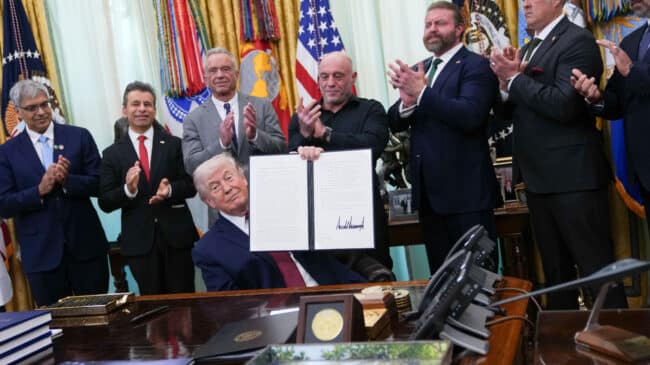


On Saturday, April 18, President Trump issued an executive order relating to the development of psychedelic substances as medicine. This represents a remarkable moment in the arc of post-1970’s drug policy: We have a Republican administration formally directing federal agencies to accelerate access to psychedelic drugs—including ibogaine, psilocybin, and LSD—as potential treatments for serious mental illnesses like major depressive disorder and substance abuse disorder.
In recent years, emerging research has shown that psychedelic substances increase neuroplasticity within the brain, allowing the brain to become physically healthier and younger. This phenomenon holds a litany of implications. Psilocybin has shown remarkable potential to change the trajectory of long-term depression and has been recognized by the U.S. Food and Drug Administration (FDA) as a ”breakthrough therapy.” LSD has shown remarkable results in alleviating general anxiety disorder and was also recognized as a ”breakthrough therapy.” Ibogaine holds a unique potential to regenerate damaged brain tissue and could be a treatment for opioid addiction or traumatic brain injury. Each holds potential promise for neurodegenerative diseases like Alzheimer’s that affect millions of Americans.
To this end, the order directs several concrete, historic steps. First, it directs the FDA to grant Priority Review Vouchers to qualifying psychedelic drugs with breakthrough therapy designation (including MDMA, psilocybin, and LSD). These vouchers are designed to accelerate reviews of critical new drugs by 1 to 2 months, instead of the typical 10 to 12 months.
Second, the order instructs the FDA and Drug Enforcement Administration (DEA) to create a pathway for ibogaine and other psychedelic compounds to qualify under the federal Right to Try Act, which allows patients with life-threatening conditions to access promising treatments even before they have received full FDA approval. With a doctor’s certification of eligibility, patients can access these treatments after they have cleared just the first of three phases of clinical testing required by the FDA.
Third, the order allocates at least $50 million through the Advanced Research Projects Agency for Health (ARPA-H) to support state-level psychedelic treatment programs. This provision would allow the FDA to, for example, gather data on the effectiveness of psilocybin therapies offered through existing state-licensed clinics in Oregon, Colorado, or New Mexico and use this real-world evidence to evaluate the safety and efficacy of these treatments, as Reason Foundation has previously recommended.
Additionally, several states are enacting laws to establish a public-private partnership among states, private drug developers, and medical research institutions to launch a consortium to conduct a clinical trial that seeks potential approval of ibogaine as a novel therapeutic for a variety of neurological conditions. Texas, Arizona, and Mississippi have all enacted legislation to this effect over the past year, though none have yet reached the stage of establishing a working platform for a multistate consortium.
Fourth, the order requires an agreement between the U.S. Department of Health and Human Services (HHS), the FDA, and the U.S. Department of Veterans Affairs (VA) to share data from relevant clinical studies conducted by other executive departments and agencies with the FDA to facilitate expedited new drug evaluation and approval.
Last, and perhaps most significantly, the order directs the attorney general to initiate and complete rescheduling review for any Schedule I psychedelic that completes Phase 3 clinical trials and earns FDA approval. This provision creates a direct pathway to bring compounds like psilocybin or ibogaine (or their related synthetic analogues) out of the most restrictive drug classification in federal law.
The combination of accelerated drug approval pathways, Right to Try expansion, rescheduling directives, and federal investment makes this arguably the most aggressive federal move on psychedelic medicine to date. Further, it comes at a moment when states have begun taking significant action on psychedelic policy reform, positioning the federal government as a supportive partner.
The new executive order will almost certainly add momentum to the efforts states have already taken to advance the availability of psychedelic therapies. It also creates new opportunities and incentives for states considering legislation related to psychedelics, including acting as a prime mover of the multistate ibogaine research consortium. Despite early momentum and flash, the Texas effort appears to have run into political headwinds that will almost certainly slow its progress, but the prospect of a federal partnership may make leadership within this consortium more attractive for other states to consider.
A key policy challenge states must overcome in developing ibogaine is that it isn’t patentable, which limits the incentive for private investment. Bringing a new drug to market in the United States frequently costs more than $1 billion due to regulatory compliance costs. Drugmakers typically only invest in a drug project if they believe they can recoup these costs after approval, usually because they hold a time-limited monopoly on the drug’s manufacture. Because of the barriers the FDA erects, some level of public funding is often the only way to bring about research into non-patentable drugs.
The new executive order tackles this challenge from both sides: It simultaneously eases the regulatory costs that cause this misalignment of incentives and contributes $50 million in federal research dollars to help offset the remaining costs. This funding could be paired with private investment, philanthropic contributions, and state dollars to bring ibogaine clinical trials to completion. Over the next 20 years, states will receive billions of opioid settlement dollars that are restricted for purposes that ameliorate the opioid crisis, including the development of a novel therapy.
The opportunities available for federal-state partnership resulting from the executive order are immense and could ultimately lead to the approval of multiple psychedelic substances as approved drugs in the United States. These therapies hold the potential to help Americans break free of the country’s major mental health challenges, including opioid addiction.