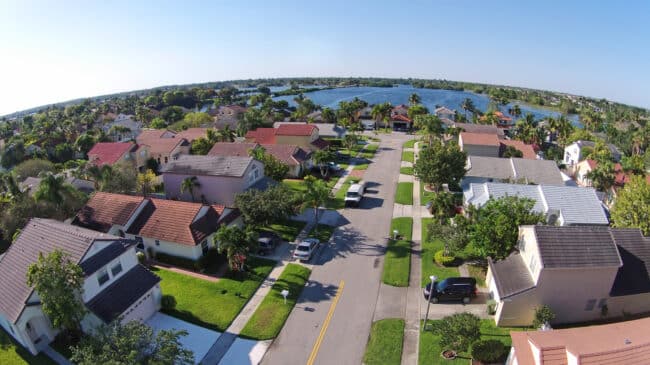

Reason Foundation has partnered with the DeVoe L. Moore Center at Florida State University and the Florida Policy Project to develop the new Florida Housing Data Project, an interactive webpage that provides housing data and analysis for the state and each of its counties. The tool enables residents and elected officials to view local-level housing trends, track shortages in single-family and rental units, and determine whether their local market has been in balance, surplus, or deficit over time.
Florida has a housing shortage of over 120,000 units. A household must make at least twice the median income in Florida to afford the median home in Florida. Increasingly, homeownership in Florida is leaving lower and middle-income families behind. The reason for this is that Florida cities and counties have failed to issue new housing permits at a rate that keeps up with new population and housing demand.
This happens in many ways:
- Permitting delays can prolong projects for months or even years, which, unfortunately, drives up housing costs.
- Restrictive zoning locks in low-density, single-family development and often ignores the demand for smaller homes, townhomes, and apartments.
- Limited adoption of flexible solutions such as accessory dwelling units (ADUs) and residential duplex units (RDUs), which could be blended gradually into neighborhoods while aiming to preserve local charm and character.
- Local politics that turn housing developments into battlegrounds. Add layers of complexity, uncertainty, and costs that restrict developers, entrepreneurs, and locals from adding housing supply in a timely and sustainable manner.
The consequences ripple through the state’s economy and quality of life. Businesses cite housing costs as a barrier to attracting and retaining workers. Families can be pushed farther from jobs, stuck with long commutes, and are often forced into trade-offs between housing, childcare, and health care.
With straightforward housing supply numbers tailored for local use, citizens and policymakers alike can see how deeply the housing shortage cuts into their communities—and why fixing Florida’s broken housing system is no longer optional.
Visit the Florida Housing Data Project to learn more.