

Among the first challenges people face upon release from prison is obtaining identification documents required to obtain a job, rent an apartment, or open a bank account. Without a photo ID, birth certificate, or Social Security card, formerly incarcerated individuals cannot access the employment, housing, and financial services that facilitate successful reentry.
Reintegrating people released from incarceration into society poses a significant policy challenge in the United States. There are approximately 1.3 million people currently incarcerated in state and federal prisons. The vast majority of them will eventually return to their communities, joining the 5 million Americans who have previously served time in prison.
Upon release, the formerly incarcerated continue to face a wide array of restrictions on their legal rights, civic participation, and employment. These challenges contribute to high recidivism rates, with approximately half of those released from state prison returning within three years. This cycle of reoffending and reincarceration not only imperils public safety but also diminishes economic productivity, separates families, erodes civic culture, and siphons more taxpayer dollars into incarceration year after year.
A new report from Reason Foundation documents significant variation in state-level assistance programs designed to provide identification documents to individuals reentering society from incarceration. The report reveals substantial gaps in both program coverage and legislative frameworks across the United States. The report includes detailed profiles of all 50 states, documenting each state’s statutory provisions, administrative policies, and implementation strategies.
Key findings
The report surveyed statutory provisions, administrative regulations, and agency practices across all 50 states for three essential credential types: photo identification cards, birth certificates, and Social Security cards.
Identification cards
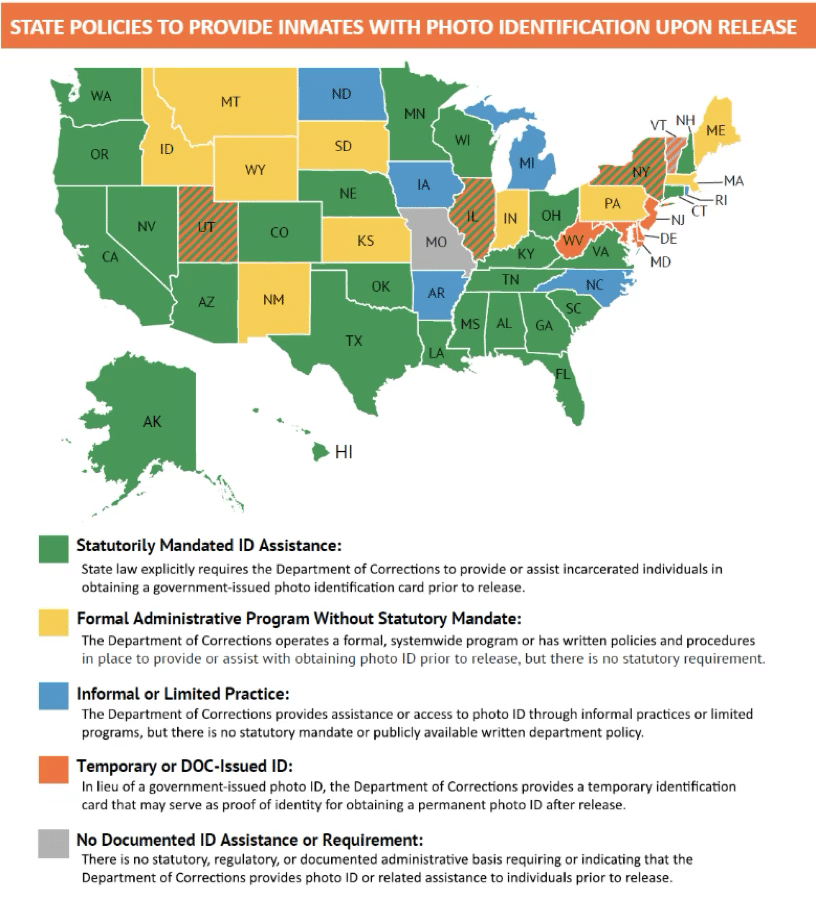
- Twenty-eight states (Alabama, Alaska, Arizona, California, Colorado, Connecticut, Florida, Georgia, Hawaii, Illinois, Kentucky, Louisiana, Minnesota, Mississippi, Nebraska, Nevada, New Hampshire, New York, Ohio, Oklahoma, Oregon, Rhode Island, South Carolina, Tennessee, Texas, Virginia, Washington, and Wisconsin) have enacted laws that explicitly direct the state corrections agency to provide or assist incarcerated individuals in obtaining a photo identification card prior to release.
- Corrections agencies in 16 additional states (Arkansas, Idaho, Indiana, Iowa, Kansas, Maine, Massachusetts, Michigan, Montana, New Mexico, North Carolina, North Dakota, Pennsylvania, Rhode Island, South Dakota, and Wyoming) operate such programs without a statutory mandate. In 10 of these states (Idaho, Indiana, Kansas, Maine, Massachusetts, Montana, New Mexico, Pennsylvania, South Dakota, and Wyoming), we identified published, written policies or procedures governing the provision of photo IDs.
- Five states (Delaware, Maryland, New Jersey, Vermont, and West Virginia) issue temporary identification cards that can be used to obtain permanent documentation post-release. In Illinois, New York, and Utah, inmates may receive a permanent ID if they are able to obtain the necessary supporting documentation; otherwise, they may be issued a temporary identification card.
- We were unable to identify any statutory or regulatory basis for providing photo IDs to incarcerated individuals in Missouri.
Birth certificates
- Fifteen states (Alabama, Arizona, California, Colorado, Florida, Georgia, Hawaii, Kentucky, Maryland, Minnesota, New Jersey, Ohio, Oklahoma, Tennessee, and Virginia) have enacted laws explicitly requiring correctional agencies to assist eligible inmates in obtaining a certified copy of their birth certificate.
- In 21 additional states (Connecticut, Idaho, Indiana, Kansas, Louisiana, Maine, Massachusetts, Michigan, Montana, Nebraska, Nevada, New Mexico, New York, North Carolina, North Dakota, Oregon, Pennsylvania, Rhode Island, South Dakota, West Virginia, and Wyoming), agencies operate such programs absent a statutory requirement. Of these, 14 states (Connecticut, Indiana, Maine, Massachusetts, Montana, Nebraska, Nevada, New Mexico, New York, Oregon, Pennsylvania, South Dakota, West Virginia, and Wyoming) have published policies or procedures outlining their approach.
- We found no clear statutory, regulatory, or publicly available policy basis for assisting inmates with birth certificate access in 14 states (Alaska, Arkansas, Delaware, Illinois, Iowa, Mississippi, Missouri, New Hampshire, South Carolina, Texas, Utah, Vermont, Washington, and Wisconsin).
Social Security cards
- Fifteen states (Alabama, Arizona, California, Colorado, Florida, Georgia, Hawaii, Kentucky, Maryland, Minnesota, New Jersey, Ohio, Oklahoma, Tennessee, and Virginia) have adopted laws mandating that correctional agencies assist eligible individuals with obtaining a Social Security card.
- In 21 other states (Connecticut, Idaho, Indiana, Kansas, Louisiana, Maine, Massachusetts, Michigan, Montana, Nebraska, Nevada, New Mexico, New York, North Carolina, North Dakota, Oregon, Pennsylvania, Rhode Island, South Dakota, West Virginia, and Wyoming), agencies provide this assistance through programs or partnerships despite the absence of statutory direction. Fourteen of those states (Connecticut, Idaho, Indiana, Maine, Massachusetts, Montana, Nebraska, Nevada, New Mexico, Oregon, Pennsylvania, South Dakota, West Virginia, and Wyoming) have published procedures or written policies governing the process.
- We found no clear statutory or regulatory basis for providing assistance with Social Security card replacement in 14 states (Alaska, Arkansas, Delaware, Illinois, Iowa, Mississippi, Missouri, New Hampshire, South Carolina, Texas, Utah, Vermont, Washington, and Wisconsin).
Overview of state implementation strategies
States have pursued a variety of approaches to assisting inmates with obtaining a photo identification card. Assisting inmates with obtaining a Social Security card and a certified copy of their birth certificate generally involves establishing memoranda of understanding between the state corrections agency, the federal Social Security Administration, and state offices of vital statistics. Corrections agencies have also generally adopted standard procedures for compiling necessary information and coordinating with relevant agencies as part of the reentry planning process.
States have adopted three primary models for implementing photo ID assistance during incarceration, each with distinct characteristics and resource requirements:
Mobile units
Transportation agencies deploy mobile Department of Motor Vehicles (DMV) units equipped with photography and credential-printing equipment to correctional facilities. This model offers flexibility and scalability, allowing a single unit to serve multiple facilities while also providing services to rural communities. However, the mobile nature limits processing capacity at each location.
Transportation agency-operated embedded facilities
State motor vehicle agencies establish permanent offices within correctional facilities, staffed by agency personnel. This approach provides on-demand processing capacity without requiring corrections staff training, but requires sustained inter-agency coordination and resource allocation.
Corrections agency-operated embedded facilities
Transportation agencies provide equipment and training, while corrections agencies operate the facilities. This model grants corrections agencies greater operational control and may be more sustainable long-term, though it requires initial capital investment and ongoing staff allocation.
These models are not mutually exclusive. Several states have successfully implemented hybrid approaches combining embedded facilities at major institutions with mobile units serving smaller facilities.
States should pursue legislative reforms
While informal inter-agency cooperation has enabled program implementation in some jurisdictions, these programs should be codified in state legislation to ensure their long-term success and improvement. Legislative mandates survive administrative turnover, shifting budget priorities, and changes in agency leadership that may threaten discretionary programs.
Beyond ensuring these programs have long-term support not solely contingent on agency discretion, codifying these programs also provides the opportunity for oversight and revision. For instance, Virginia House Bill 2221 mandates an ID program, requires the correctional agency to create a report on how many credentials were actually provided, and asks the department to produce a legislative recommendation for altering the bill to improve the ID program.
Ensuring access to basic identification documents represents a relatively low-cost intervention with significant potential to facilitate successful reintegration and reduce recidivism. By removing unnecessary administrative barriers to employment and self-sufficiency, states can enhance public safety, reduce correctional expenditures, and facilitate the reintegration of returning citizens into productive economic participation.
The full report, From Prison to Paperwork: A 50-State Survey of Policies on Reentry Identification Documents, includes comprehensive state-by-state profiles detailing specific statutory citations, administrative policies, and program implementation approaches for all 50 states.