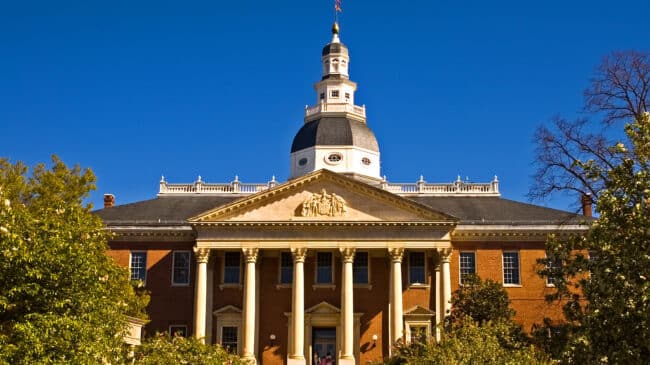

Maryland Gov. Wes Moore signed House Bill (HB) 557 into law earlier this year, establishing a process for people with criminal records to ask state licensing agencies whether their record will disqualify them from an occupational license before they invest time and money in training.
An occupational license is a government-issued state credential that many workers must obtain before they can legally work in fields ranging from cosmetology to contracting. Nationally, roughly one in five workers holds a job that requires an occupational license, according to Bureau of Labor Statistics data. Maryland itself requires licensure or certification for at least 131 occupations according to the Archbridge Institute’s 2025 State Occupational Licensing Index.
For the estimated 500,000 Marylanders with a felony or misdemeanor conviction record, licensing requirements are also a source of uncertainty. Someone could spend months or years completing the required coursework, apprenticeship hours, and exam fees for a trade like cosmetology or HVAC repair, only to be denied a license because of a conviction from years earlier.
HB 557, sponsored by Del. Andrea Fletcher Harrison (D-District 24), took effect on July 1. Prior to this bill’s passage, Maryland law already limited how licensing boards could use criminal history. The state’s five major licensing departments were prohibited from denying a license solely because an applicant has a conviction unless the board finds a direct relationship between the conviction and the occupation or concludes that licensure would pose an unreasonable risk to public safety. Additionally, applicants whose sentences ended at least seven years prior to their application for licensure and who had no new offenses since could not be denied based upon that old conviction at all.
What Maryland lacked was a way for applicants to get an answer before completing the training and education requirements for a license. Someone with a conviction had no way to know whether a board would ultimately approve or deny their application until after they had already sunk the time and money into qualifying for it.
Under the new predetermination process created by HB 557, an applicant can ask a covered department to review their criminal history and determine whether it would disqualify them from a specific license before they apply. That determination is binding on the department unless the applicant’s criminal history materially changes afterward. If a department determines the applicant would be denied, it must explain why, citing the same factors used in ordinary licensing decisions, including the seriousness of the offense, time elapsed, and evidence of rehabilitation. Applicants can request an updated determination after a year or if their record changes. Departments may charge up to $100 for a review, but must waive the fee for applicants at or below 300% of the federal poverty level.
HB 557 is written as a three-year pilot that will sunset on June 30, 2029, unless the legislature decides to continue it. The law requires the affected departments to use existing staff and resources to conduct these reviews, rather than hiring new personnel, and to report to the legislature by October 2028 on how many predetermination requests they received and what it cost to process them.
As Del. Harrison noted in testimony submitted to the House Economic Matters Committee:
Current data show that previously incarcerated people face unemployment rates many times higher than the general population, and those barriers are especially acute during the first few years after release, when stable employment is critical to successful re–entry and public safety. With approximately 19 percent of Maryland jobs requiring a license or certificate, ensuring a fair and transparent path to licensure can unlock economic opportunity, strengthen families, and reduce recidivism.
John Dove, the commissioner for Occupational and Professional Licensing with the Maryland Department of Labor, also testified in support of HB 557, saying:
This legislation reflects a thoughtful effort to ensure our licensing systems are fair and accessible while still maintaining standards necessary to protect the public. From our work, we consistently hear from Marylanders with prior justice system involvement who are unsure about whether their criminal record makes them ineligible for licensure. … Qualified and capable Marylanders often never apply, cutting themselves off from professional opportunities before taking the necessary steps to start the process.
Reason Foundation contributed to the legislature’s consideration of HB 557 through technical assistance, educational outreach to lawmakers, and public testimony.
HB 557 passed the House, 96-28, and the Senate unanimously, 45-0, reflecting broad, bipartisan recognition that Marylanders who have served their time deserve a clear answer before they invest in training. With HB 557, Maryland joins more than 25 other states, including Kentucky and West Virginia, that have adopted predetermination processes for occupational licensing.