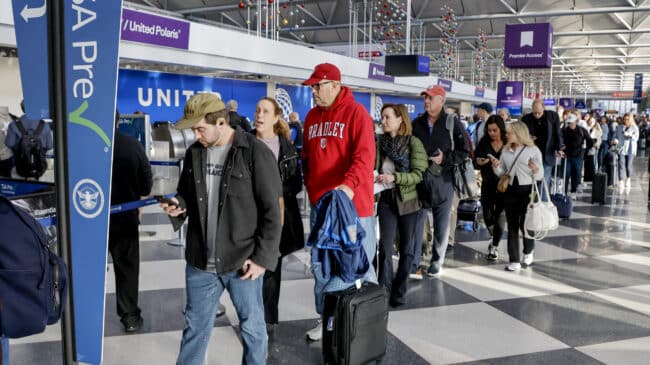

On Nov. 6, the Federal Aviation Administration (FAA) issued an unprecedented emergency order requiring airlines to reduce flights in an attempt to relieve pressure on air traffic control staff. Air traffic controller staffing has been a problem for many years, but the recent government shutdown has resulted in controllers going without pay for more than a month. This personal financial strain led to a dramatic increase in air traffic controllers calling out sick, triggering flight delays and cancellations.
The FAA’s new order that airlines limit flights at 40 major airports is meant to stabilize traffic flow and ensure safe operations, at the cost of tens of thousands of Americans experiencing flight cancellations each day. This unfortunate situation was entirely avoidable and is impossible in most of the rest of the world. That’s because most countries have converted their air navigation service providers into public utilities that operate independently of national government budgets.
What the FAA’s emergency order requires airlines to do
The FAA’s Emergency Order Establishing Operating Limitations on the Use of Navigable Airspace came into force on Nov. 7. Airlines at 40 “High Impact Airports,” which account for the vast majority of air traffic in the United States, are required to reduce their daily scheduled flights between 6 a.m. and 10 p.m. Required flight cuts begin at 4% today, increase to 6% on Nov. 11, then 8% on Nov. 13, and finally peak at 10% on Nov. 14 and beyond.
Airlines’ initial planned flight cancellations through Nov. 14 were to be filed with the FAA on today, and are to be submitted seven days in advance on a rolling schedule going forward. Even at the initial 4% reduction, this translates to tens of thousands of Americans receiving cancellation notices for their previously booked flights.
The impact will be even more severe than if airlines could freely select the lowest-volume flights to cancel because the FAA’s order imposes a requirement that carriers must reduce by marketing code, rather than operating certificate. Large mainline carriers have outsourced their short-haul routes to regional airlines, such as American Airlines, which operates its American Eagle-branded subsidiaries, including Envoy Air, PSA Airlines, and Piedmont Airlines, as well as contract carriers Republic Airways and SkyWest Airlines. Each of these airlines flies under a separate operating certificate, but all are marketed as American.
In its order, the FAA recognizes that major airlines would have an incentive to reduce smaller-capacity regional flights operated under separate certificates from the mainline carrier. As such, the FAA requires that flight reductions be calculated by marketing code and that reductions for any single operating certificate shall not exceed 15%. This will undoubtedly ensure more geographic equity in flight cuts, but will also result in more travelers being impacted.
In addition, the order puts airlines on notice that failure to comply can result in fines of up to $75,000 per flight operated over a carrier’s limit.
To further ease airspace congestion, all commercial space launches and reentries are prohibited between 6:00 a.m. and 10:00 p.m.
How to make air traffic control shutdown-proof
This unfortunate situation was completely avoidable. It’s also impossible in most of the rest of the world. This is because most countries have converted their air navigation service providers into public utilities since 1987.
According to Reason Foundation’s 2025 Annual Aviation Infrastructure Report, 98 countries are served by air traffic control utilities, which collect user fees from their aviation customers to fund day-to-day operations and finance improvements. Just 24 countries provide air traffic control through legacy FAA-style civil aeronautics authorities, mostly in developing countries in Africa, Asia, and the Caribbean.
The two main reasons why most of the world has moved on from the World War II-era FAA model are:
- Regulatory independence: There is an inherent conflict of interest when a regulator provides the service that is tasked with regulating. Since 2001, the International Civil Aviation Organization (ICAO) has urged member states, including the United States, to separate the provision of air navigation services from its regulation. The non-compliant FAA model is increasingly uncommon as countries around the world have moved to adopt consensus regulatory best practices.
- Financial independence: Air traffic utilities charge cost-based user fees based on ICAO consensus charging principles. This makes them independent from government budgets and allows them to issue revenue bonds to finance major improvements quickly. Free from the strings attached to government funding, air traffic utilities tend to focus on efficiency-enhancing modernization projects. Because utilities are able to finance improvements based on expected future revenue, these projects and their benefits to customers are delivered much more rapidly and cost-effectively.
Reason Foundation’s Robert Poole has been researching and advocating for air traffic control governance reform for more than 40 years. He has long argued in favor of converting the FAA’s Air Traffic Organization into an independent public utility. This approach has enjoyed bipartisan support in the past, although certain special interests have been successful in derailing reform. As he wrote days ago, “Depoliticizing the U.S. ATC system would be the most effective way to insulate it from inevitable future government shutdowns. Building the coalition to get this done should begin now.”