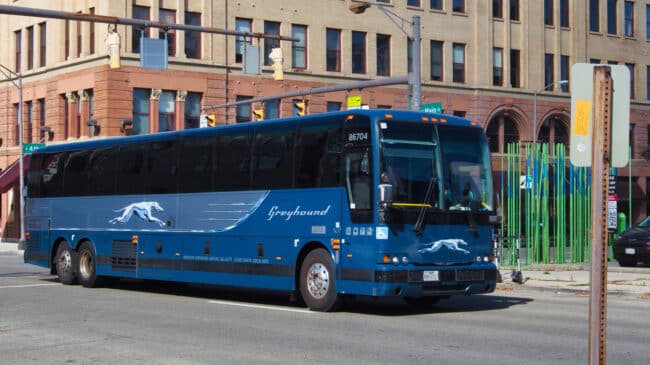

The case studies below are excerpted from the study, “Evaluating Amtrak and intercity bus performance for smarter federal investment,” which compares eight intercity Amtrak routes with comparable bus routes in categories including ticket pricing, convenience and accessibility, travel speed, profitability, subsidy reliance, and on-time performance.
The geographically diverse set of routes examined in the study includes Washington, D.C. to New York City; Pittsburgh to Washington, D.C.; Miami to Orlando; Charlotte to Atlanta; Dallas to Austin; Denver to Salt Lake City; Spokane to Seattle; and San Jose to Los Angeles.
While there are caveats and nuances in these figures and comparisons, the average per-passenger subsidy on the eight Amtrak routes examined in this study was $109.85 per rider. Excluding the Northeast Corridor route, the average Amtrak subsidy per passenger rises to $129.06 on the other seven Amtrak routes, ranging from a low of $90.70 per passenger on the Pittsburgh–Washington, D.C. route to a high of $164.10 per passenger on the Denver–Salt Lake City route.
The only subsidy data available for bus routes was on Flixbus/Greyhound routes, where the range of subsidy varied between no subsidy at all to up to $6 per route mile. Of the eight bus routes studied, two require subsidies to operate. Three of the eight bus routes were commercially viable and would not need subsidies. Lastly, three of the eight lacked sufficient publicly available information on operating costs to make an adequate estimate.
Setting aside subsidies, so customers could see ticket prices they would pay when traveling between these cities, the review of eight intercity routes found average ticket prices were lower on buses on six out of eight routes and lower on Amtrak on two routes. The average Amtrak ticket price was $58.50, and the average bus ticket price was $45.38.
Comparing travel times between the same cities, travel times were faster on buses on seven out of eight routes, and trips were faster on Amtrak on only one route, Washington, D.C. to New York City.
Comparing the on-time performances of Amtrak and buses serving these eight routes, Amtrak trains arrived on time an average of 57 percent of the time. For intercity bus routes, data was only available for Flixbus and Greyhound routes. Amtrak’s on-time performance was better than bus performance in three of the five routes where bus on-time data were available.
For each of the eight routes, this analysis compares existing Amtrak service with intercity bus options between the same two cities, revealing stark contrasts between an aging, resource-intensive rail network and a more efficient bus system.
Pittsburgh to Washington, D.C.
The first case study evaluates Amtrak’s Capitol Floridian between Pittsburgh and Washington, D.C., and compares it with a Greyhound option on the same route.
Amtrak’s Capitol Limited also goes between Chicago, Cleveland, Washington, D.C., and Pittsburgh. The Capitol Floridian is a combination of the temporarily discontinued Capitol Limited and Silver Star. This study uses relevant five-year data based on Amtrak’s projections for the Capitol Limited.
For this route, Amtrak’s Capitol Floridian is about 15% more expensive than the Greyhound alternative and takes around 24% longer to reach its destination.
The Greyhound route is profitable and receives no per-passenger subsidy, whereas Amtrak operates the Capitol Floridian route at a loss of $90.70 per passenger. Seventy percent of Amtrak trips on this route are on time, while only 39% of Greyhound trips on the same route are on time.
Table 1: Pittsburgh to Washington, D.C. Route Comparison
| Category | Amtrak Floridian | Greyhound |
|---|---|---|
| Ticket Price | $59 for coach, $327 for private room | $50 |
| Convenience & Accessibility | Well-equipped stations, accessibility features, daily departure | Basic amenities, accessible stations, multiple daily departures |
| Speed & Travel Time | 7 hours 45 minutes | 5 hours 55 minutes |
| Profitability and Subsidy Information | With subsidy, the operating loss is ~$90.70 per passenger | No subsidy, commercially viable |
| On-Time Performance | 70% | 39% |
For a rider, Greyhound is a better option when cost is the main consideration. If a rider has budgeted a sizable amount of time for travel, they may find Amtrak’s extra costs and longer trip duration worth the tradeoff, doubly so when considering Greyhound’s tardiness on this route. Amtrak also offers more options onboard, like the dining cars on many routes.
From a policy perspective, Greyhound is also a better option on this route. The route requires no subsidy and is profitable, a notable improvement over Floridian’s forecasted FY 2025 loss of $90.70 per rider.
Spokane to Seattle, Washington
The second case study evaluates Amtrak’s Empire Builder between Spokane and Seattle with a Flixbus option traveling the same route. Amtrak’s Empire Builder also goes between Portland, Seattle, Havre, St. Paul, Milwaukee, and Chicago.
For this route, Amtrak’s Empire Builder is much closer to parity with Flixbus’ route pricing. Amtrak charges $67 for coach compared to Flixbus’ $65. Amtrak’s route does take significantly longer than Flixbus’ direct route. Amtrak’s Empire Builder is also frequently delayed, with only 51% of trains arriving on time compared to Flixbus’ 63% on-time performance.
Table 2: Spokane to Seattle Route Comparison
| Category | Amtrak Empire Builder | Flixbus |
|---|---|---|
| Ticket Price | $67 for coach, $257 for private room | $65 |
| Convenience & Accessibility | First class seating, accessible stations, daily departure | Basic amenities, accessible stations, multiple daily departures |
| Speed & Travel Time | ~8 hours 10 minutes | ~5 hours 10 minutes |
| Profitability and Subsidy Information | With subsidy, the operating loss is ~$133.40 per passenger | No subsidy, commercially viable |
| On-Time Performance | 51% | 63% |
For riders, Flixbus is a marginally cheaper, faster, and more reliable option for this route. The Empire Builder does offer higher-end travel arrangements, including the dining car that is common on Amtrak long-distance routes and café service.
From a policy perspective, Flixbus is still a better option—the Empire Builder operates at a staggering $133.40 loss per passenger, compared to the commercially viable Flixbus route, which requires no direct subsidy.
Dallas to Austin, Texas
The third case study evaluates Amtrak’s Texas Eagle between Dallas and Austin, with a Greyhound option that follows the same route. Amtrak’s Texas Eagle also goes between Chicago, St. Louis, Dallas, San Antonio, Los Angeles, and Austin.
Table 3: Dallas to Austin Route Comparison
| Category | Amtrak Texas Eagle | Greyhound |
|---|---|---|
| Ticket Price | $20 for coach, $122 for private room | $30 |
| Convenience & Accessibility | Well-equipped stations, accessible features, daily departure | Basic amenities, accessible stations, multiple daily departures |
| Speed & Travel Time | 6 hours 35 minutes | 3 hours 30 minutes–3 hours 40 minutes |
| Subsidy Information | Receives significant federal subsidies | Partial subsidy on Ft. Worth to Austin portion of route |
| Profitability and Subsidy Information | With the subsidy, the operating loss is $121.60 per passenger | Assumed subsidy rate of $6 per route-mile between Fort Worth and Austin, not commercially viable without partial subsidy |
| On-Time Performance | 60% | 47% |
For this route, Amtrak’s Texas Eagle is cheaper than the Greyhound equivalent. The Texas Eagle does still take nearly twice as long as the Greyhound route, but it is $10 cheaper for a coach ticket. Despite that longer trip duration, the Texas Eagle (arriving on time 60% of the time) is more consistent than Greyhound’s bus route (arriving on time only 47% of the time).
For a rider, Amtrak’s route is cheaper—but both routes are cheap enough so that time considerations may outweigh price concerns. Still, for the amenities onboard, the lower cost, and higher on-time performance, the Texas Eagle is the clear winner for a consumer less concerned about scheduled arrival time.
From a policy perspective, both routes require some subsidy. Assuming Greyhound’s subsidy is $6/route-mile between Fort Worth and Austin compared to Amtrak’s Texas Eagle running a loss of $121.60 per passenger, both require some level of subsidy to remain competitive. Requiring a subsidy for a mode to operate is generally less favorable than if it were able to operate independent of that funding, though it’s unlikely, even with the maximum assumed subsidy for Greyhound, that it would amount to the subsidy required to operate the Texas Eagle.
Washington, D.C. to New York City
The fourth case study evaluates Amtrak’s Northeast Regional between Washington, D.C. and New York City compared with a Megabus option traveling the same route. Amtrak’s Northeast Regional goes between Boston, Providence, New York City, Philadelphia, Washington, D.C., and Newport News.
For this route, Amtrak’s Northeast Regional tickets vary heavily in price depending on the time of departure. The lowest fare offered for coach was $25 per ticket, and the highest was $78 per ticket. On this route, Amtrak’s options take 20% less time than the Megabus route.
For a rider comparing the two routes, Amtrak’s Northeast Regional wins in both costs (assuming a rider can get a ticket on the lowest fare option) and in time spent. Amtrak’s Northeast Regional routes also arrive on time 78% of the time—a much better performance when compared to the 53% of long-distance routes that arrive on time for Amtrak, so the Northeast Regional is also consistent in schedule, and seems to be a clear winner.
Table 4: Washington, D.C. to New York City Route Comparison
| Category | Amtrak Northeast Regional | Megabus |
|---|---|---|
| Ticket Price | $25–$78 for coach, $159–$229 for business class | $35 |
| Convenience & Accessibility | High-quality seating, services, accessible stations, multiple daily departures | Basic amenities, accessible stations, multiple daily departures |
| Speed & Travel Time | 3 hours 27 minutes–3 hours 39 minutes | 4 hours 20 minutes |
| Profitability and Subsidy Information | Operating profit of $24.60 per passenger | Not Available |
| On-Time Performance | 78% | Not Available |
From a policy perspective, it’s hard to make any assumptions about how much Megabus would receive in subsidy (if any) to maintain this route, so we can only look at Amtrak. The Northeast Regional is one of Amtrak’s few profitable routes nationwide (though that profitability does not consider capital costs). The Northeast Regional generates an operational income of $24.6 per rider, not requiring as heavy a subsidy as other Amtrak routes. Still, it’s impossible to assume between the two which is better from a policy perspective without Megabus’ data. But, if Amtrak were to trim its service routes to those that were self-sustaining, it’s clear that the Northeast Regional would be one of the routes continued.
San Jose to Los Angeles, California
The fifth case study evaluates Amtrak’s Coast Starlight compared to a Flixbus option traveling the same route from San Jose, in the Bay Area, to Los Angeles. Amtrak’s Coast Starlight goes between Seattle, Portland, Sacramento, Los Angeles, and San Jose.
Table 5: San Jose to Los Angeles Route Comparison
| Category | Amtrak Coast Starlight | Flixbus |
|---|---|---|
| Ticket Price | $92 for coach, $281 for private room | $50 |
| Convenience & Accessibility | Comfortable seating, dining services, accessible stations, daily departure | Basic amenities, accessible stations, multiple daily departures |
| Speed & Travel Time | 10 hours 45 minutes | 6 hours 20 minutes–7 hours |
| Profitability and Subsidy Information | With the subsidy, the operating loss is $127.50 per rider | No subsidy, commercially viable |
| On-Time Performance | 58% | 33% |
For this route, Amtrak’s Coast Starlight’s coach tickets are $42 more expensive than the cheapest Flixbus direct route—nearly doubling the price—and the trip takes anywhere from three to four hours longer than the Flixbus route’s scheduled time.
For a rider comparing the two routes between both cities, Amtrak’s Coast Starlight only pulls ahead in comfort level and consistency, given access to the train’s dining car serving breakfast, lunch, and dinner. But for a more cost-conscious traveler, Flixbus’ route makes more sense.
The Coast Starlight’s low on-time performance is still better than Flixbus’, with the Coast Starlight arriving on time 58% of the time compared to Flixbus’ dismal 33%, when the bus route wasn’t canceled for the day. Schedule flexibility may also be a factor. The Coast Starlight has one daily departure, compared to Flixbus’ multiple daily departures along this route.
From a policy perspective, the Flixbus route requires no operating subsidy—the whole route is commercially viable. The Coast Starlight relies heavily on federal subsidies, given that it runs an operating loss of $127.50 per rider.
Orlando to Miami, Florida
The sixth case study evaluates Amtrak’s Silver Meteor compared with a RedCoach option traveling the same route. Amtrak’s Silver Meteor goes between Miami, Tampa, Savannah, Raleigh, Washington, D.C., New York City, and Orlando.
For this route, the Silver Meteor’s coach tickets are $5 more expensive than RedCoach’s premium economy class seating. However, Amtrak’s coach option is cheaper than both of the upgraded tickets that the RedCoach route offers. The Silver Meteor’s trip duration ranges from 1 hour and 10 minutes longer to 2 hours longer than the routes offered by RedCoach. Booking availability for RedCoach is more flexible, however, with multiple daily departures on various buses with different comfort features. For example, the RedCoach First Class bus has 21-inch-wide seats compared to Economy’s 16-inch-wide seats and recliners, but it does run at different times compared to the Economy routes. The Silver Meteor’s 49% on-time performance may also deter travelers, though it’s impossible to compare directly as RedCoach does not publish its on-time performance.
Table 6: Orlando to Miami Route Comparison
| Category | Amtrak Silver Meteor | RedCoach |
|---|---|---|
| Ticket Price | $26 for coach, $229 for private room | $21 for premium economy, $30 for business class, $40 for first class |
| Convenience & Accessibility | Comfortable seating, meals, accessible stations, daily departure | Onboard amenities and comfort features based on ticket class, accessible buses, multiple daily departures |
| Speed & Travel Time | 5 hours 40 minutes | 3 hours 40 minutes–4 hours 30 minutes |
| Profitability and Subsidy Information | With subsidy, operating loss of ~$125.40 per passenger | Not Available |
| On-Time Performance | 49% | Not Available |
For a traveler comparing the two, the Silver Meteor’s amenities and relatively low price may make it worth it, even with the increased travel time between the two cities, though a time-conscious rider may think twice, given the low on-time performance of the route. Additionally, with only one daily departure, the Silver Meteor’s bookings are rigid compared to RedCoach’s flexibility.
From a policy perspective, it’s not possible to compare the two routes due to data availability. While we know Amtrak’s Silver Meteor runs at a loss, we can’t assume that RedCoach’s route is 100% profitable without any cross-subsidization between routes.
Charlotte, North Carolina, to Atlanta, Georgia
The seventh case study evaluates Amtrak’s Crescent between Charlotte and Atlanta compared with a WandaCoach option travelling the same route. Amtrak’s Crescent goes between Atlanta, Charlotte, Washington, D.C., and New York City.
Table 7: Charlotte to Atlanta Route Comparison
| Category | Amtrak Crescent | WandaCoach |
|---|---|---|
| Ticket Price | $66 for coach, $656 for private room | $27 in-app price, $35 web price |
| Convenience & Accessibility | Basic onboard amenities, stream-limited onboard WiFi, and two daily departures | Basic onboard amenities, stream limited onboard WiFi, two daily departures |
| Speed & Travel | 5 hours 48 minutes | 3 hours 15 minutes–4 hours 15 minutes |
| Profitability and Subsidy Information | With subsidy, operating loss of $140.70 per rider | Not available |
| On-Time Performance | 57% | Not available |
For this route, Amtrak’s coach tickets are nearly three times as expensive as WandaCoach’s in-app seat cost, and just under two times as much as WandaCoach’s website seat cost. WandaCoach’s scheduled route times vary from three hours and 15 minutes to four hours and 15 minutes, given that it only runs the route twice a day, whereas the Crescent is scheduled to take 5 hours and 48 minutes for its daily departure between the cities.
For a rider, WandaCoach’s price is appealing, though its onboard amenities are limited compared to Amtrak’s Crescent. Like many other long-distance Amtrak routes, the Crescent features an onboard dining car, brought back as of June 2024. WandaCoach’s two departures per day leave early, at 4:45 am and 6:45 am, but that’s still more flexibility than Amtrak’s one departure per day. Overall, a rider’s tradeoffs are simple—better amenities and a departure later in the day, or a cheaper and faster ride from Charlotte to Atlanta.
From a policy perspective, it’s hard to support a route that loses $140.70 per rider each day, though it is hard to compare the two directly because of the limited information available on WandaCoach’s profitability on this route.
Denver, Colorado, to Salt Lake City, Utah
The eighth and final case study compares Amtrak’s California Zephyr between Denver and Salt Lake City with a Greyhound option traveling the same route.
Amtrak’s California Zephyr goes between Emeryville, Reno, Denver, Omaha, and Chicago.
Table 8: Denver to Salt Lake City Route Comparison
| Category | Amtrak California Zephyr | Greyhound |
|---|---|---|
| Ticket Price | $113 for coach, $645 for private room | $85 |
| Convenience & Accessibility | Basic amenities, accessible stations, and daily departure | Basic amenities, accessible stations, daily departure |
| Speed & Travel Time | 14 hours 29 minutes | 10 hours 10 minutes |
| Profitability and Subsidy Information | With subsidy, operating loss of $164.10 per rider | Assumed subsidy-rate of $6/route-mile for route-miles through Wyoming, not fully commercially viable without subsidy |
| On-Time Performance | 33% | 50% |
For this route, Amtrak’s California Zephyr’s coach service is 25% more expensive than a ticket on the Greyhound route and takes 30% longer than the Greyhound route, assuming no delays, and delays are very likely on the California Zephyr. The Zephyr is Amtrak’s worst-performing long-distance route, with only 33% of trains arriving on time compared to Greyhound’s 50% on-time arrival for this route. It has one scheduled daily departure, tied with Greyhound for this lengthier route.
For a rider, Amtrak may be more worthwhile solely for the added comfort of an Amtrak train, including access to the dining car, given the longer trip. The Greyhound route does take less time than Amtrak on this route, but this is still the longest route featured in this analysis by a large margin. The Greyhound route is expensive compared to other intercity bus routes featured in this analysis as well, though that is sensible for the route’s duration. The same is true for Amtrak’s, though it’s closer to the costs on some of its other routes (notably the Coast Starlight). A rider’s choice would likely come down to whether they are willing to spend the extra $28 for the added comfort on what will be a longer journey on board the California Zephyr.
From a policy perspective, the Greyhound route is partially subsidized on its route miles through Wyoming. For the purposes of this comparison, that rate is assumed to be $6 per route-mile. Amtrak’s California Zephyr runs at a loss of $164.10 per rider as well. It’s unlikely that the subsidy the Greyhound route receives for the miles in Wyoming is anywhere close to the sum Amtrak requires to keep the Zephyr operational, given those rates.
You can find more on these case studies and the full study here: Evaluating Amtrak and intercity bus performance for smarter federal investment.