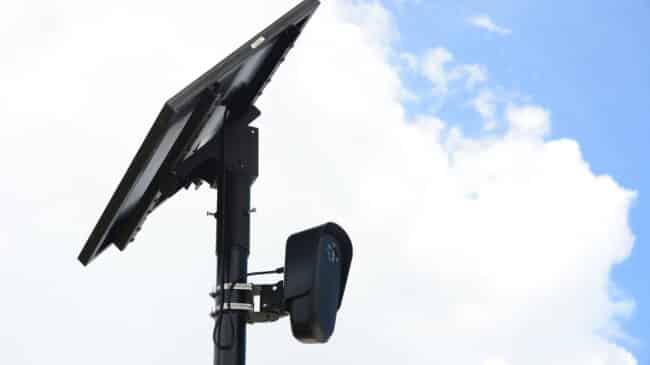

Automated license plate readers (ALPRs) have spread to thousands of American communities faster than almost any policing technology in memory. Flock Safety, one among many ALPR vendors, now operates approximately 120,000 cameras nationwide.
Stories of misuse and abuse abound, including warrantless searches of movement histories, informal ICE access to camera networks despite state laws forbidding it, a Kansas police chief who used the system to stalk his ex-girlfriend, and a driver held at gunpoint because a reader misread her plate. Such stories would make any libertarian squeamish, though public backlash against the technology extends well beyond libertarian circles.
But what is the argument in favor of ALPRs? Writing in The Atlantic, the Manhattan Institute’s Charles Fain Lehman makes an ostensibly measured case in defense of Flock. He argues that ALPRs will help solve more crimes and thereby reduce crime by incapacitating and deterring criminals. Indeed, Lehman himself has compiled an impressive database of cases where ALPRs were used to help solve crimes.
Lehman doesn’t deny the privacy costs, though. He acknowledges documented abuses, and he appears to take privacy concerns seriously, conceding that a database of billions of vehicle images might be considered a major privacy intrusion (Flock’s ALPRs are currently generating about 20 billion license plate scans per month). His conclusion is that ALPRs are “likely a valuable tool” and that these concerns are real but manageable through “smart regulation, not bans.”
He’s right that an outright ban on ALPRs would be both unworkable and unnecessary. And solving more crimes is indeed a good way to increase deterrence. But his argument relies on evidence that is considerably weaker than he presents. More importantly, though, his proposal for “smart regulation” stops short of the one thing that would actually address the privacy concerns he concedes are legitimate: treating ALPR database queries like any other police search and requiring a warrant.
The research is more mixed than Lehman lets on
Lehman’s case that ALPRs are “probably” a valuable tool rests on evidence that he concedes is thin. Here’s how he characterizes the current state of research on ALPRs:
An initial wave of randomized controlled trials from the early 2010s generally found little or no crime-reducing benefit of ALPRs, except a possible reduction in drug-related crime. But these studies collected small samples from small areas and relied on now-decades-old technology. A handful of more recent papers gave reason for optimism, but use weaker research designs that do less to isolate causality. A 2017 study found ALPRs were correlated with a reduction in violent crime; a 2019 paper found suggestive but not conclusive evidence of a reduction in auto theft and robbery; and a 2025 evaluation of Atlantic City’s ALPRs found a reduction in shootings, car thefts, and property crimes. But none of these papers could prove that ALPRs caused these improvements.
Even that qualified summary manages to overstate the evidence. Lehman’s claim about a “possible reduction in drug-related crime” comes from a 2013 study by Christopher Koper, Bruce Taylor, and Daniel Woods. In that study, researchers compared officers patrolling with ALPRs to officers doing the same patrols with old-fashioned manual license plate checks instead. The analysis revealed a reduction in drug crime in ALPR patrol areas in the weeks following the intervention but not during the patrols. Even then, that reduction was offset by a corresponding rise in drug crime at the routes patrolled with manual checks, suggesting drug crime gradually migrated elsewhere. Meanwhile, ALPR patrols didn’t reduce motor-vehicle thefts or person-crimes (crimes like assault, robbery, or threats). On the contrary, car thefts and person-crimes declined in the areas patrolled without cameras (again, in the weeks following patrols but not during them). Lehman leaves this out.
Lehman’s claim that “a handful of more recent papers gave reason for optimism” doesn’t hold up either. The 2017 study he references is Andrew Wheeler and Scott Phillips’s evaluation of camera-equipped roadblocks in Buffalo, N.Y. Lehman writes that it “found ALPRs were correlated with a reduction in violent crime.” That’s true of the simplest way of comparing before-and-after crime counts. However, the authors ran another analysis designed to adjust for seasonal patterns in crime. That analysis found violent crime went up, not down, at the same locations (non-violent crime rose too). The study’s authors characterized these results as mixed and not reliable across methods.
The 2019 paper is Christopher Koper and Cynthia Lum’s study of Charlotte, N.C., which installed a large network of fixed cameras. The simple comparison showed improvements in solving motor-vehicle theft and robbery cases in the parts of the city with the most cameras. But a more careful analysis, which accounts for other differences in case characteristics, found those improvements were no longer distinguishable from chance, and the number of cameras in an area had essentially no relationship to how many cases got solved. Moreover, the analysis could not separate the effect of cameras from Charlotte’s other crime-fighting tools, including a real-time crime center and an extensive network of ordinary surveillance cameras running at the same time.
The 2025 evaluation by John Shjarback and James Sarkos is the one place where Lehman undersells the evidence. In Atlantic City, N.J., the rate at which shooting cases got solved improved, but not by enough to rule out chance. A more sophisticated analysis was even more promising, finding a reduction in shootings, car theft, and property crime overall after the camera network expanded. The catch, which the study’s authors point out, is that Atlantic City rolled out a separate crime-fighting program the same month the cameras went live. With no counterfactual to check against, the analysis couldn’t separate the two interventions or distinguish the measured declines in crime from broader national trends. Notably, most crimes—except for motor-vehicle thefts—declined nationally during the same period as the study.
In sum, only the 2025 Atlantic City study found a real, statistically significant drop in crime—and even that finding is confounded by a concurrent policy change and national crime trends. Everything else either disappeared once researchers accounted for other explanations or flipped from a decrease to an increase depending on how the data was analyzed. That’s not nothing, but it’s also not “probably.”
Lehman then reaches abroad to Medellín (Colombia), Stockholm (Sweden), Montevideo (Uruguay), and China, citing studies on surveillance cameras (think run-of-the-mill closed-circuit television cameras without the bells and whistles of an ALPR system that can be queried). He cites those studies to argue that because visible surveillance cameras reduce crime elsewhere, we should have “more confidence” that ALPRs can too, even while acknowledging “ALPRs aren’t the same thing as surveillance cameras.”
This concession undersells the problem. Those studies measure deterrence from a visible camera in a bounded space (on subway platforms, parking lots, etc.), not the tracking and searching capabilities offered by modern ALPRs. Even setting aside constitutional questions, the burden on ALPRs’ defenders is to show the technology does something beyond the deterrent effect of ordinary cameras.
Future research might support the notion that ALPRs have crime-fighting benefits, and Lehman is right to point out that most existing research examines outmoded ALPR technologies. This is sure to be an area of active research in the coming years. Within a week of Lehman’s Atlantic article, a new working paper (not yet subject to peer review) was released by Scott Mourtgos and Ian Adams. The study leverages the staggered deployment of cameras and 3,108 comparison jurisdictions without cameras to allow for causal interpretation lacking in most existing studies. The working paper’s findings suggest that Flock camera deployments in 216 jurisdictions between 2017 and 2023 may have resulted in an 11% drop in motor-vehicle thefts but had no statistically significant effect on other types of property crime (violent crime was unexamined). Clearance rates for motor-vehicle theft also rose, but their rise began before camera deployment, which undermines the notion that this finding is attributable to the cameras. Among stolen vehicles that were ultimately recovered, the time to recovery fell by a modest 0.28 days, but there was no measurable improvement in the overall rate at which stolen vehicles were recovered.
Still, the limited evidence we have is far from convincing or conclusive. Ideally, we’d like to know whether ALPRs help solve crimes that wouldn’t be solved otherwise, whether they have a deterrent effect, and whether their effects on solving and deterring crime are superior to those of regular surveillance cameras. Just as it would be foolish to ban ALPRs altogether, it’d be foolish to assume they work.
Misconduct isn’t the only concern
Lehman treats cases of police misusing ALPR systems to stalk innocent civilians as the relevant privacy cost and argues that better rules, penalties, and audit logs can address them. But misconduct is not the only concern of privacy advocates. Harder problems arise when the technology is used for legitimate enforcement purposes.
In April 2025, deputies in Brown County, Wis. (where marijuana is illegal), used Flock’s network to track Edward Abrams-Phillips’s repeated trips into Michigan (a state where marijuana is legal), then cited those trips as probable cause to search his car for drugs. Notably, Abrams-Phillips had an outstanding warrant and Flock’s cameras helped locate his vehicle, so the stop itself was a reasonable use of the technology. The problem is that the same query revealed his perfectly legal travel across state lines, which was then cited, alongside a claimed odor of marijuana, to justify a search of his vehicle. While this is only one anecdote with many caveats, it raises a legitimate concern that ALPRs may be used to bolster otherwise weak cases.
ALPRs may also undermine the quality of investigations more broadly by giving officers a false sense of certainty. In September 2025, a Flock camera in Bow Mar, Colo., correctly captured a truck matching Chrisanna Elser’s driving through town around the time a neighbor’s package was stolen. An officer treated that alone as sufficient grounds to issue her a summons and declined to review the dashcam and doorbell footage she offered showing she wasn’t involved. The department only dropped the case after Elser spent two weeks compiling evidence to clear her name.
The Institute for Justice has documented at least 31 cases of innocent drivers stopped, sometimes even held at gunpoint or jailed, due to license-plate-reader errors. Camera misreads account for only about a third of these cases. Most of the remaining cases resulted from human error like “officers entering wrong information into the system or misinterpreting what the ALPR data says,” according to the Institute for Justice’s analysis. While officer training and other safeguards can help combat these types of errors, the point is that warrantless dragnet searches will inevitably come with some degree of friction.
Lehman’s proposal for “smart regulation” stops one step short
Lehman suggests “smart regulation,” including a 30-day limit on data retention, restricted access, supervisory sign-off, logged queries, and penalties for misuse. In the time since Lehman’s article was published, Flock Safety has voluntarily adopted many of Lehman’s guardrails, but those voluntary measures still leave many workarounds. While Lehman presents many good ideas, notice what’s absent. Most ALPR database queries don’t require a warrant, and by omission, Lehman suggests they shouldn’t—even after conceding, in his own words, that “[t]he Fourth Amendment’s protections exist exactly because of the very real potential for abuse of police officers’ extraordinary powers.” Every safeguard he proposes as “smart regulation” is internal to the agency searching. But the point of requiring warrants is to provide external judicial review because internal accountability is insufficient protection against unreasonable searches.
Asked directly about warrants on X (formerly Twitter), Lehman responded that he is “skeptical that aggregating images of public conduct rises to a search in the same way that doing the same thing for potentially private conduct does.” However, he “can imagine a threshold where a warrant is appropriate!” It’s progress that he can imagine a threshold beyond which a warrant is required, but that still leaves the policy question unanswered.
In the Atlantic article, Lehman calls the general concern of mass surveillance “sound” and acknowledges that it is unclear whether the evolving theory of “mosaic” searches could extend to ALPRs. Mosaic theory, initially developed in separate opinions in 2012’s United States v. Jones, distinguishes between individual data points and the picture those data points portray when compiled together. For example, a single photo of your car passing one camera reveals very little about you. But ALPR networks do more than that; they collect information on every car that passes through the network and store it in a searchable database. This allows the government to trace where your car goes over weeks or months. From there, law enforcement can infer where you work, worship, or seek medical treatment.
The Supreme Court has never fully adopted mosaic theory as such. It was through concurrences in Jones, not the majority opinion, but the court’s reasoning has inched further in that direction in subsequent decisions. In Carpenter v. United States (2018), the court ruled that police need a warrant to get seven days or more of aggregated location history from a cell phone carrier. The Supreme Court extended the same logic earlier this year in Chatrie v. United States. In Chatrie, the court held that a “geofence warrant” (a request to a company like Google for the location history of every device that passed through an area during a set window) counts as a Fourth Amendment search. However, the court left it to a lower court to determine whether the warrant at issue in Chatrie was sufficient to satisfy the Fourth Amendment’s probable cause and particularity requirements.
Lehman doesn’t dispute any of this so much as find it unsatisfying. Again, on X, he raised a fair question: “How many ALPRs does a PD [police department] have to have before it can reconstruct movement history? Do I need a warrant to query just one ALPR? If no, how many is the threshold?” He also argued that any standard resting on how “amorphously big” a search gets “leaves a tremendous amount of ambiguity about what cops are actually allowed to do,” which he called unacceptable “in a society based on the rule of law.”
Justice Elena Kagan’s majority opinion in Chatrie explicitly rejected this sort of line-drawing, holding that what matters isn’t how much data police pull but that they can “reconstruct ‘retrospective[ly],’ and with no real effort, people’s comings and goings” at a location, without having identified a suspect to surveil in advance. Even one ALPR, queried enough times, could reveal that a particular car passes the same corner every Tuesday morning. That capability of retrospectively identifying patterns in movement is what distinguishes an ALPR system from a police officer or camera simply observing movements on the same street corner. Kagan’s rule is that “a new technology should not transform what individuals had reasonably thought they could withhold from the government.” The size and density of a network are relevant, though, because they intensify the advantage of ALPR databases relative to manual observation or reviews of camera footage.
Here again, Lehman is right that it isn’t totally clear whether or at what point ALPRs will meet the court’s evolving standard for a search. The situation is genuinely uncertain, though, and the public nonetheless appears to hold real concerns about the use of ALPRs. Avoiding the question of warrants does not resolve this uncertainty, but it does risk public backlash that is already resulting in the cancellation of ALPR system contracts along with any benefits the systems may have.
The fix Lehman is looking for already exists
The courts only set the floor for privacy limits based on the cases that come before them. Legislatures can act now to provide clarity and protect the privacy of their constituents by requiring a warrant to access ALPR data.
The Institute for Justice has drafted a model policy that attempts to strike the right balance on ALPRs. The Protecting Everyone from Excessive Police Surveillance (PEEPS) Act doesn’t attempt to ban ALPRs or any surveillance technology. Instead, it treats queries used to access historical location information as searches, requiring a judicial warrant to access information revealing where a vehicle has traveled more than 24 hours prior to the search. While a 24-hour period is admittedly somewhat arbitrary, it does provide a way of distinguishing information about specific, recent trips from longer histories that allow the government to reveal the patterns-of-life contemplated by mosaic theory.
The PEEPS Act also makes reasonable exceptions for stolen vehicle reports, genuine emergencies, toll collection, traffic enforcement, parking enforcement, and cases where consent is given. It restricts cross-jurisdictional sharing absent a court order and outright bans selling historical location data to private third parties.
This approach leaves ALPRs readily available for stolen vehicle searches where their value is most plausible and allows continued evaluation of their efficacy. The warrant requirements it imposes would not meaningfully inhibit investigations either, as similar standards already apply to searches of homes and cellphones.
In fairness, the PEEPS Act is rather broad in its application, regulating government access to any database that “contains photos, videos, license plate data, facial recognition data, cell site location data, or any combination of these.” A more targeted approach may impose similar warrant requirements on ALPRs specifically, or some collection of related surveillance technologies. Lehman is right that outright banning ALPRs would be foolish. He’s also right that the privacy threat is real, and he proposes several good ideas for improving accountability. However, if querying a database with billions of license plate scans is the kind of search that implicates the Fourth Amendment, then the proper remedy is to require a warrant