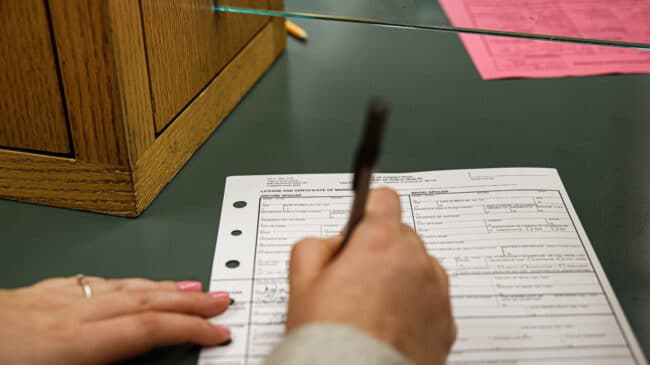


Access to gainful employment can reduce the likelihood of criminal recidivism. Yet state occupational licensing restrictions create unnecessary government-imposed barriers that prevent people with criminal records from accessing stable careers, undermining both individual rehabilitation and public safety.
Occupational licensing restrictions create significant barriers to employment for people with criminal records.
- One in five workers is required to hold an occupational license, and many licensing boards categorically deny applicants with criminal records—even when convictions are unrelated to the occupation.
- Research finds that stable, gainful employment significantly reduces recidivism.
- However, people with prior convictions don’t know if their record disqualifies them until after they’ve completed all the licensing requirements and submitted their application. This uncertainty creates a barrier to entry and can waste applicants’ time and money.
West Virginia recently adopted positive reforms, but significant gaps remain.
- In 2021, West Virginia enacted reforms establishing a “rational nexus” standard for considering conviction records and creating a predetermination process so applicants can petition a licensing authority to determine if their record is disqualifying before investing in required training and fees.
- However, the “rational nexus” standard leaves boards with broad discretion which may still result in arbitrary denials and the predetermination process was limited to people who had not previously applied for a license.
House Bill 4819 would improve West Virginia’s current licensing laws by:
- Replacing the “rational nexus” standard and instead requiring boards to determine that a conviction directly and specifically relates to the duties and responsibilities of the occupation before denying an applicant based on their criminal record.
- Expanding predetermination eligibility to individuals who have previously applied for—but not held—a license.
- Requiring licensing boards to consider specific evidence of rehabilitation.
- Prohibiting licensing boards from considering arrest-only records or non-violent convictions after 5 years of good behavior.
These reforms align West Virginia with policy in other states.
- Since 2017, 44 states and the District of Columbia have enacted occupational licensing reforms to reduce barriers for people with criminal records.
- At least 26 states have adopted predetermination processes like the one expanded by HB 4819, including recent reforms in Virginia (2025), Colorado (2024), Nebraska (2024), and South Dakota (2024).