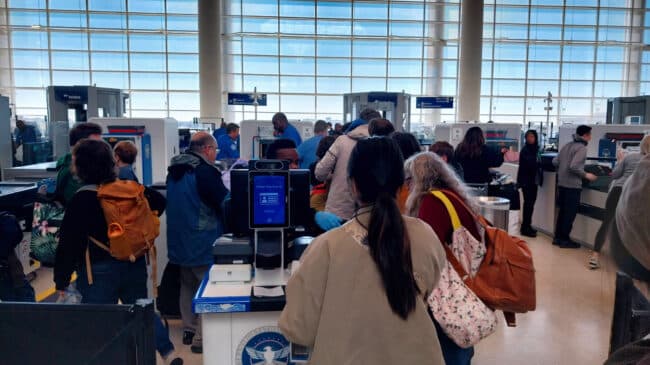

- DHS shutdown highlights airport security system’s flaws
- NTSB collision report cites FAA failures
- “FAA and aviation policy reform: the time is now”
- FAA reorganization plan muddies the waters
- NASA’s obsolete Moon launch program
- JSX and other public charters keep growing
- Boom Supersonic’s dual-use engine
- News Notes
- Quotable Quotes
Partial Shutdown Highlights Flaws in Making TSA the Airport Security Screener and Regulator
Members of Congress went home for the weekend last Thursday afternoon, leaving the Department of Homeland Security (DHS) unfunded. Acting Transportation Security Administration (TSA) Administrator Ha Nguyen McNeill had warned lawmakers that if DHS funding lapsed, the 61,000 TSA screeners at airports would be required to keep working without pay. If the funding lapse continues this week, the result could be long airport security lines like those experienced during the 43-day federal government shutdown.
In the immediate aftermath of the 9/11 terrorist attacks, and since, I have argued that when Congress created the TSA, it made a fundamental mistake. Congress combined the airport security regulator with an airport screening business. That amounts to self-regulation. TSA has a serious conflict of interest.
All other aspects of airport security, including perimeter access control, lobby control, and security of other areas, are the responsibility of airports under TSA regulatory supervision. But for passenger and baggage screening, TSA provides the screening and regulates itself.
The far wiser solution would be for TSA to regulate airport-employed (or contracted) screeners. Under this model, airport operators could either employ their own airport security screeners (consistent with TSA regulations) or contract with a TSA-certified screening company. With this model, airport screening would be immune to federal government shutdowns.
In Europe, airport security is the responsibility of the airport operator. Screening is handled by the airport or by a security company, depending on the country.
Last year, my Reason Foundation colleague Marc Scribner outlined legislation that could separate the provision of U.S. airport security screening from its regulation, allow airports to contract directly with private security providers, and convert the 9/11 Security Fee into a dedicated local user fee.
NTSB Report on DCA Collision Cites FAA Safety Regulation Failures
As I perused recent media articles on the National Transportation Safety Board’s (NTSB) assessment of the Jan. 2025 airliner/helicopter collision at Reagan National Airport (DCA), what struck me most was its calling out numerous failures of the Federal Aviation Administration’s (FAA) role as the aviation safety regulator. Here are some of those from the Jan. 27, 2026 NTSB hearing.
The following quotes are from Sohail Husain’s Jan. 30, 2026 article from the Eno Center for Transportation:
- “The probable cause [includes] the FAA’s placement of the helicopter route near the DCA runway and failure to evaluate the risk of the route placement.”
- “The lack of safety risk assessments at DCA.”
- “FAA’s failure to implement previous collision avoidance recommendations.”
- “FAA’s placement of [helicopter] Route 4 was a probable cause of the crash, which points to a structural error embedded in the airspace design.”
- “The risk of a collision around DCA is not new. One reported incident involved an airplane coming within 200 feet of a helicopter, forcing the plane to abort its landing to avoid a collision. This near-miss led to the creation of the DCA Helicopter Working Group. The working group recommended the relocation of Route 4, which the FAA did not implement.”
- “NTSB highlighted two compounding factors that can intensify [controller] workloads. First, air carriers cluster scheduled arrivals at the beginning and end of two-hour slot blocks, creating periods of concentrated flight arrivals. Second, the DCA tower received ‘less than requested miles-in-trail.’ Collectively, these factors compress arrival spacing and leave controllers less time to identify and resolve conflicts.”
- “In May 2023, operators at the Potomac [TRACON] submitted a proposal to FAA to reduce the arrival rate…. This proposal did not reach the proper management at FAA for consideration, suggesting a safety-management gap, where signals from the field are not reaching decision-makers.”
- “NTSB pointed to limitations in collision avoidance technology and FAA’s failure to implement previous recommendations as contributing factors in the accident.”
- “FAA provides the Army with an exemption on using ADS-B Out during military operations.”
- “NTSB found that the Safety Management System for the Air Traffic Organization was not functioning as a robust risk-control mechanism.”
- “NTSB also concluded that the ATO did not foster a positive safety culture, noting that operators felt pressure of retaliation for raising safety concerns. . . . This reflects an organizational problem at the FAA that prevents risks from being surfaced and resolved.”
Each of these points reveals serious failures of the FAA as this country’s aviation safety regulator. Blame should not be focused on the Air Traffic Organization (ATO), because its job is to manage and operate the ATC system, subject to FAA safety regulation. In a well-run national aviation system, the aviation safety regulation function is organizationally separate (at arm’s length) from the ATC system operator. This has been the International Civil Aviation Organization (ICAO) policy since 2001, and today at least 94 countries comply with this policy, according to data from the Civil Air Navigation Services Organization (CANSO), shown in Table 5 in Marc Scribner’s Annual Aviation Infrastructure Report: 2025. Whatever else Congress does in the next FAA reauthorization, separating the Air Traffic Organization from the FAA’s safety regulatory function is essential.
In Senate testimony on Feb. 12, NTSB chair Jennifer Homendy criticized the FAA’s safety culture, in which safety issues were not consistently addressed despite repeated warning signs. She noted that during investigations, “numerous [FAA] people were afraid to talk to us. . . . I can’t tell you the number of people who were just scared to speak up because they were worried about retaliation.”
A closely related problem is political pressure from airlines and Congress to add more flights at DCA than this airport can safely handle. Each time an FAA reauthorization bill comes up, members of Congress—especially those who live farthest from Washington, D.C.—argue for adding flights and/or airlines to this overloaded airport. Months before the NTSB findings, the Washington Post ran a major article headlined, “Crush of Flights Routinely Strained National Airport Capacity Before Crash.” Here are a few quotes from that article.
- “FAA’s failure to act on warnings that too many planes were being squeezed into the airport has emerged as a crucial focus of investigations into the crash.”
- “An internal FAA review following the accident found that the airport generally was in ‘noncompliance’ when it came to ensuring adequate distances between planes lining up to land.”
- “The NTSB record shows that the FAA did not act to reduce traffic at peak periods in any systematic way.”
- “A memo written by Bryan Lehman, a traffic manager at the TRACON that feeds flight to National, . . . argued that [flight reductions] were necessary to maintain a safe and efficient operation. In July, Lehman testified that his manager told them that [FAA] would not pursue the change, citing political considerations on Capitol Hill.”
- “Clark Allen, who was the operations manager at National’s tower at the time of the crash, told investigators the plan to slow arrivals was shot down by more-senior FAA management.”
- “Joshua Gosseling, the operations manager at the TRACON . . . said he unsuccessfully recommended to his bosses that FAA more-strictly oversee traffic at the airport.”
A reformed FAA, with the safety regulatory function clearly separated from the Air Traffic Organization, would be the best way to resist pressure from members of Congress, because FAA safety regulators would be in a stronger position to resist increased flights as unsafe, since they would be more than the airport and the ATO can safely and effectively handle.
“FAA and Aviation Policy Reform: Now Is the Time”
Recently, I came across a report in my files with the above ambitious title. It was produced in 2013 by the FAA Management Advisory Council (MAC) and released in Jan. 2014. Among the MAC members were Gina Marie Lindsey (LAX), Jack Pelton (Cessna), John Porcari (US DOT), Paul Rinaldi (NATCA), and Steve Van Beek (then of Leigh Fisher). If you google this document, the AI Overview includes the following points:
- Structural separation of the Air Traffic Organization from FAA safety regulation;
- Funding reform: shifting ATC funding from federal taxes to ATC user fees;
- Governance changes: establishing a new ATC governing board;
- Accelerating ATC modernization; and,
- Eliminating redundant regulatory oversight.
I looked for this landmark document on the FAA website, but I could not find it there. But the Google search did provide a URL where you can find it: the Reason Foundation. Years ago, we saved this landmark report, uncertain whether the FAA itself would save it. It appears we were right.
FAA Reorganization Muddies the Waters
On Jan. 26, the FAA rolled out a large-scale reorganization of the agency, nominally to strengthen air safety. Unfortunately, it divides rather than combines its safety regulatory functions, and it partly dismantles the Air Traffic Organization.
Let’s first look at how it will weaken the ATO. As many will remember, the ATO was created as a substitute for separating air traffic control (ATC) from the FAA as the national aviation safety regulator. The Clinton administration had proposed taking ATC out of the FAA and making it into a self-supporting utility (analogous to the Tennessee Valley Authority). The idea came from Vice President Al Gore’s reinventing government shop and was directly inspired by New Zealand’s ATC system, having been separated from its national government in 1987. When the planned US Air Traffic Services (USATS) legislation failed in Congress, President Clinton issued Executive Order 13108 to create the Air Traffic Organization as a new division within the FAA, headed by a chief operating officer.
The current FAA reorganization undercuts the intended role of the ATO by creating a separate FAA “Airspace Modernization Office” that would include the Program Management Organization (PMO). While the current PMO has problems, taking it out of the ATO would convert the ATO into just the operator of the ATC system. This would be a further departure from the global movement that has led to nearly 100 Air Navigation Service Providers (ANSPs) that are similar in function and structure to the pioneer, Airways New Zealand.
And instead of “strengthening” the FAA’s aviation regulatory role, the plan divides it into two. The new Aviation Safety Oversight and Certification Organization would report to the deputy administrator, while the new Aviation Safety Management System Organization would report to the administrator. This makes no more sense than carving up the ATO.
This is an ill-conceived reorganization plan that would undercut the Air Traffic Organization and weaken the FAA’s vital air safety regulation function. I have no idea what a Department of Transportation (DOT) secretary can do when one of his modal agencies makes a seriously flawed decision, but I hope someone on Sean Duffy’s management team takes a hard look at this fiasco.
NASA’s Obsolete Moon Launch Program
As you’ve undoubtedly read by now, the planned launch of NASA’s Artemis II mission (planned to take four astronauts around the Moon and back) has been postponed from this month to early March. The cause of this postponement was a fuel leak from the SLS launch vehicle during a “wet” dress rehearsal for the February launch. Space.com provided the perfect headline for this event: “NASA Had 3 Years to Fix Fuel Leaks on its Artemis Moon Rocket. Why Are They Still Happening?”
This goes to the heart of the problem with NASA still employing 1960s technology and operating procedures despite the revolution brought about by the private sector, including reusable booster rockets, commercial technology, rapid prototyping, and a modus operandi of build/launch/revise and launch again. SpaceX was the pioneer in this approach, which is now being emulated by other start-ups—but it’s still foreign to the legacy aerospace/defense contractors.
The giant SLS booster rocket is nicknamed the Senate Launch System, since its concept was dictated by Congress (mostly in the Senate) as an effort to do the 1960s Apollo Moon launch program over again. The Senate legislation actually provided design requirements for SLS and its Orion capsule. It also required that it use engines and solid rocket boosters left over from the Space Shuttle program. And of course, it continued to make use of no-bid, cost-plus contracts with the same aerospace/defense giants used for Apollo and the Shuttle.
One of the worst outcomes of these mistakes is that, depending on how the numbers are crunched, each launch of SLS/Orion costs in the vicinity of $4 billion. That completely rules out frequent test launches to fine-tune design and performance. That is why SLS has been launched only once, and that mission led to a flawed re-entry of its Orion capsule, whose heat shield partially disintegrated. NASA’s fix is not to redesign the heat shield but to change its re-entry path to reduce the chance of it burning up. What this means is that four SLS/Orion astronauts will be depending on this untested re-entry scenario, with NASA betting their lives solely on NASA’s modeling of the proposed re-entry trajectory.
Risking these astronauts’ lives in this manner is unconscionable. On PJ Media last month, aerospace expert Robert Zimmerman called for NASA to take the crew off the Artemis II mission. He points to the damaged heat shield on the previous re-entry, which NASA has declined to fix. It is betting that the altered re-entry trajectory will prevent potentially fatal consequences upon re-entry. He also notes problems with Orion’s environmental system, which has never been tested in flight. The sensible alternative he proposes is to fly Artemis II without a crew, to test whether the Orion capsule is safe for humans. If all goes well, that would make Artemis III a crewed flight around the Moon and Artemis IV the Moon landing.
JSX and Other Public Charters Keep Growing
JSX is the best known of a category of air carriers called public charter operators. Based on several federal air regulations (FAR), they are limited to aircraft with no more than 30 seats, and they are exempt from several regulations, such as mandatory pilot retirement at age 65. They specialize in connecting small airports (with little or no main-line airline service) to larger airports. They are not allowed to sell tickets or operate their aircraft. So they are set up with the public charter company selling tickets and a separate company operating as the direct air carrier. Much of this information comes from an article in Flight Global by Jon Hemmerdinger.
Public charter operators include the best-known JSX and also Aero, Contour, and SkyWest Charter. Both JetBlue and United Airlines have invested in JSX, while American and Southwest appear to see them as unfair competitors. Pilots’ unions, such as ALPA, lobby against them.
In a Dec. 17 JDA Journal article, Sandy Murdock reported that the Trump administration has, in effect, said “the door is open” for such public charters. By contrast, the Biden administration had been developing regulations to curtail their operations.
As someone who views airline competition as a boon to air travelers, I’m glad to see this useful sector expanding (and several of my friends are fairly long-time JSX customers). So I was delighted to read Graham Warwick’s Aviation Daily article, “JSX Making the Case for Electra’s Ultra-STOL EL9.” I have written several times about the EL9, a super-STOL nine-seat aircraft that can take off and land in 150 feet. JSX recently disclosed that in 2023, it signed a letter of intent with Electra for 89 EL9s. Warwick explains that JSX sees this nine-passenger craft as a good fit for very small airports for very short trips—such as Dallas to Fort Worth or Fort Worth to McKinney, TX. Many of those trips could link a small-town airport to a larger airport for a longer-distance trip on a conventional airline.
I note with interest that this is one of the markets that electric vertical take-off and landing (eVTOL) developers and potential operators hope to serve. But I will once again remind readers that electric vertical take-off and landing is very energy-intensive, so I expect the same trip to be far more economically viable on an EL9 than any eVTOL. JSX and Electra have spotted a market niche a lot more promising than comparable eVTOL trips.
Boom Supersonic’s Dual Role Engine
A start-up company planning to build and fly a Mach 1.7 supersonic airliner was bound to encounter skepticism, but especially so after it decided not to buy an existing jet engine from a well-known jet-engine producer but to design and build its own. But many skeptics (including me on this engine subject) are now taking the engine decision more seriously. Guy Norris explained why in an article in Aviation Week (Jan. 12-25, 2026).
Norris first reminds us of the successful test flight of Boom’s XB-1 technology demonstrator a year ago and then discusses progress on its Symphony engine, aimed at producing 40,000 lbs. of thrust. But the big news in Norris’s article is that the engine, not yet in production, is being ordered by a non-aviation company as a power source for data centers. The data-center version is called Superpower, and was recently ordered by Crusoe, a company building its first data center in Abilene, TX, as part of OpenAI’s Stargate project. Its initial order is for 29 Superpower units, fueled by natural gas and with a full rated output of 42 megawatts.
Boom CEO Blake Scholl told Norris that “We are going to get hundreds of thousands of hours of ground test data essentially for free. . . We’ll be able to go to the FAA and say ‘We’re walking in with the ‘most-tested engine core that anyone has ever brought you.’”
The lengthy two-page article has a lot more details about the engine and its ongoing development and testing. After reading this, I am more optimistic than before about Boom Supersonic’s future.
Denmark Plans Copenhagen Airports Stake Sale
Last year, the Danish government bought out its pension-fund investors in Copenhagen Airports, ending up owning 98.6% of its shares. But last month, reported Infralogic (Jan. 23), the government acknowledged working with Rothschild to help it plan the sale of 49.9% of the shares to outside investors. Copenhagen Airports owns both the major hub Copenhagen Airport and the much smaller Roskilde Airport.
Is Charging Landing Fees “ADS-B Misuse”?
General aviation organization AOPA is promoting a bill called the Pilot and Aircraft Privacy Act (PAPA). The measure is intended to prevent airports that serve private planes from identifying aircraft via their ADS-B signal to make it easier for them to collect their landing fees. The bill would prohibit the use of ADS-B data to assist in collecting fees from pilots or aircraft owners, which AOPA calls “ADS-B misuse.” The bill was introduced by two Republicans, Rep. Bob Onder (Missouri) and Sen. Ted Budd (North Carolina).
Austin Airport Terminal Capacity to Double
A story on Fox Channel 7 in Austin reported that Austin-Bergstrom International Airport plans to spend $5 billion over the next decade to add 32 more gates, nearly doubling its current capacity. The article notes that seven airlines (Alaska, American, Delta, FedEx, Southwest, United, and UPS) have signed 10-year use-and-lease agreements agreeing to the expansion. The new Concourse B will have 32 gates, nearly doubling the 34 existing ones. But Memo to Headline Writers: This is not “doubling the size of the airport,” as the Channel 7 story was headlined. An airport consists of the airfield and the terminals. The last I knew, there were no plans to expand the acreage of Austin-Bergstrom, a former Air Force base.
Should Federal Policy Reduce the Controller Academy Washout Rate?
The DOT Office of Inspector General announced on Feb. 6 that it will open a probe into high failure rates at the FAA Academy. This is a misguided idea. An aviation consultant who was formerly an FAA controller explains the tests required of Academy students, noting that the Academy washout rate remains near the historical average of around 30%—which he thinks is fine. He explains that this rate weeds out those “without the inherent capability to be an effective air traffic controller.” It would be a huge waste of time and money for such a person to reach “journeyman” status at a control tower or TRACON. He or she would be highly likely to wash out there, after having spent several years and lots of money seeking the impossible.
Brazil Planning Rio Airport Auction for March 30
Aviation Daily (Feb. 5) reported that Brazil’s Ministry of Ports and Airports will hold an auction on March 30 for a long-term concession of Galeao International Airport. The sale auction will be open to all qualified companies. State airports company Infraero holds 49% of Galeao, and a portion is owned by Vinci Compass. Infraero is auctioning off its stake, and the new concessionaire will pay Infraero 20% of its gross annual revenue each year until 2039. Galeao is Brazil’s second-largest airport.
More Hybrid Aircraft Announced by Startup Companies
Given the relatively short range and low payload enabled by all-electric propulsion, companies continue to unveil innovative hybrid alternatives. As reported by Aviation Week (Sept. 15-28, 2025), French startup Ascendance last fall unveiled its Atea VTOL hybrid with a projected range of 215 nm carrying four passengers and a pilot. Its fore and aft wings also enable a longer range than most eVTOL alternatives with similar passenger capacity. Another interesting hybrid is Canadian company Evio’s 50-100-seat hybrid airliner, with four wing-mounted turboprops plus battery-powered electric motors. Its initial offering is planned to be an 88-seat airliner with up to 500 nm range. (Aviation Week, Dec. 22, 2025/Jan. 11, 2026).
FAA DCA Helicopter Ban is Made Permanent
The FAA has replaced its year-old temporary flight restriction (TFR) on helicopter flights around Reagan National Airport (DCA) with a permanent ban. The interim final rule will be finalized after a public comment period. Only “essential” helicopter flights in this airspace will be allowed, which includes “lifesaving medical, active law enforcement, active national security, and continuity activities for the president or vice president,” per Aviation Daily’s Jan. 26 report.
Blue Origin Plans Increased New Glenn Launch Rate
Blue Origin’s reusable New Glenn booster will graduate this year to an increased launch rate, reported Irene Klotz in Aviation Week (Nov. 24-Dec. 7, 2025). On the New Glenn agenda for 2026 is sending a cargo version to a lunar landing and finalizing its planned seven national security launches by winning National Security Space Launch certification (NSSL) via several more test launches.
Italy Plans Privatization of Catania Airport
Italy’s sixth-busiest airport (and Sicily’s largest) is Catania Airport (SAC), which is on the way to privatization. Its current owners, including the Chamber of Commerce of South-East Sicily, are in the final stages of planning to sell 51-66 %) of the airport’s shares. Infralogic (Jan. 26) reported that potential bidders include 2i Aeroporti, SAVE Group, and Blackstone-backed Mundys (which operates Rome Fiumicino). Also considering a bid is Argentina-based Corporacion America, which owns large shares of the Florence and Pisa airports. Infralogic speculates that other potential bidders may include Spain’s Aena, France’s Vinci Airports, Germany’s Fraport, and Royal Schiphol Group in the Netherlands. The newsletter estimates the airport’s value at between €400 and €500 million.
Southwest Adding Secondary Flight Deck Barriers to its Fleet
In compliance with its Safety Management System (SMS), Southwest Airlines has begun installing secondary flight deck barriers aft of the cockpit doors in its all-737 fleet. To the best of my knowledge, Southwest is the first US airline to take this step. (Aviation Week, Jan. 12-25, 2026)
Vinci Airports Upgrading Cape Verde Airports
One of the world’s five largest investor-owned airport companies, Vinci Airports, holds a 40-year concession for the seven airports serving these islands. Its concession company, Cabo Airports S.A., has obtained €40 million from the Emerging Africa & Asia Infrastructure Fund to expand the seven airports, including terminal expansions, runway extensions, and other improvements. Project lenders include the International Finance Corporation, DEG, and Proparco, according to Infralogic’s Jan. 27 article.
Perspectives on U.S. eVTOL Certification
A thoughtful discussion of the benefits for eVTOL companies that will be the first to win FAA certification is “The 1sts in Line for EVTOL TC Have Advantages, but 2nds Will Have Important Benefits.” This is a commentary from former FAA Chief Counsel Sandy Murdock in the Jan. 12 issue of his JDA Journal. He draws on a review article from Flying magazine, as well.
Angola’s New Airport Gets Private Operator
Aviation Daily (Jan. 8) reported that Angola’s newly opened $3 billion airport—Antonio Agostinho Neto International Airport—will be managed and further developed by Corporacion America Airports, in partnership with construction firm Mota-Engil, under a 20-year concession. The airport’s first phase includes one terminal capable of serving 15 million annual passengers and a cargo terminal for 130,000 metric tons/year. One of its two planned runways is currently in operation.
Error in Last Month’s Issue
In the January article on the air traffic controller shortage, I failed to spot and correct a typo on the loss of controller trainees during the 43-day federal government shutdown. The actual number cited by FAA Administrator Bryan Bedford was 400 to 500—not the 4,000 to 5,000 that appeared in that story’s first paragraph. My apologies.
“Under the current system, the ticket tax paid by every commercial airline passenger goes into a ‘trust fund’ that was intended to finance capital improvements of air traffic control. But that trust fund is an illusion. It sits there with an $18 billion surplus that is being used for deficit offset purposes rather than being invested in new technology. As a result, in inflation-adjusted dollars, investment in air traffic control has steadily diminished over many years. Meanwhile, the strains on the system are increasing because of more use by corporate jets and commercial space operators who pay virtually nothing to use the system. That’s why the opposition to change is actually led by the business jet industry. And I expect that commercial space operators like Elon Musk, who get a free ride today, are also content with the status quo.”
—Will Ris, retired VP Government Affairs of American Airlines and former Vice Chair of the FAA Management Advisory Council, email to Robert Poole, Feb. 9, 2026 (used with his permission)
“Even as NASA celebrated the rollout of the Space Launch System rocket and Orion spacecraft for Artemis II over the weekend, NASA’s new administrator Jared Isaacman made sure to put an asterisk on the program’s future. ‘The architecture you see behind us here with SLS and the Orion spacecraft is just the beginning,’ he said Saturday appearing with the four astronauts set to fly past the moon, ‘Now, over time, launching missions like this, we are going to learn a lot, and the vehicle architecture will change. And as it changes, we should be able to undertake repeatable, affordable missions to and from the moon.’”
—Richard Tribon, “NASA Head Isaacman Tempers Artemis Praise,” Orlando Sentinel, Jan. 25, 2026